Taxonomic Remarks
This species was not reported since the 19th century in the Mediterranean Sea. An award will be granted by the CIESM to any documented, reliable / verifiable evidence (published paper / Ph.D thesis / photo) reporting the species after that date (Ref. 116564).
Ambiente: milieu / zona climatica / distribuzione batimetrica / gamma di distribuzione
Ecologia
marino; acqua dolce; salmastro demersale; oceanodromo (Ref. 51243); distribuzione batimetrica 25 - ? m (Ref. 114953). Subtropical; 35°N - 40°S, 120°W - 160°E (Ref. 114953)
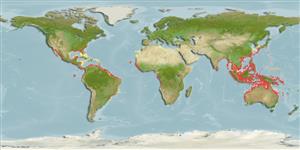
Circumglobally in tropical and subtropical waters, entering estuaries and littoral lagoons and ascending river courses (Ref. 81284, 81624). Western Atlantic: Florida and Louisiana, USA to Brazil (Ref. 7251); eastern Atlantic: Portugal to Angola, including the western Mediterranean Sea (Ref. 4429; no report since the 19th century [Ref. 116564] ); western Pacific: northern Australia, from western Australia to Queensland (Ref. 7300); eastern Pacific: Gulf of California to Ecuador (Ref. 4429). In freshwater it can be found in rivers of West Africa (Ref. 81284), Ogowe River (Ref. 81284) and the Congo River estuary (Ref. 377, 81284).
Lunghezza alla prima maturità / Dimensione / Peso / Età
Maturità: Lm 300.0, range 300 - 300 cm
Max length : 750 cm TL maschio/sesso non determinato; (Ref. 57708); common length : 250 cm TL maschio/sesso non determinato; (Ref. 4429); Età massima riportata: 30 anni (Ref. 57533)
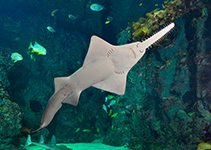
Diagnosis: Rostral blade with 20 or fewer pairs of rostral spines (Ref. 81624).
Body shape (shape guide): elongated.
A euryhaline species (Ref. 57533). Inhabits inshore coastal waters to moderate depth, also around off lying islands. Found also in estuaries, lagoons, river mouths, and even freshwater. Feeds on fishes and bottom-living animals. Ovoviviparous. Apparently can reproduce in freshwater (Ref. 57533). Freshwater populations occur to about 750 km up Amazon River; populations in Lake Nicaragua may be non-migratory (Ref. 7251). Reaches sexual maturity at 8-10 years and females have litters of approximately 1-13 pups. Young spend much of their early life in rivers up to 400 km from the sea (Ref. 114953).
Ciclo vitale e comportamento di accoppiamento
Maturità | Riproduzione | Deposizione | Uova | Fecondità | Larve
Ovoviviparous, embryos feed solely on yolk (Ref. 50449).
Stehmann, M., 1990. Pristidae. p. 51-54. In J.C. Quero, J.C. Hureau, C. Karrer, A. Post and L. Saldanha (eds.) Check-list of the fishes of the eastern tropical Atlantic (CLOFETA). JNICT, Lisbon; SEI, Paris; and UNESCO, Paris. Vol. 1. (Ref. 4429)
Stato della Lista Rossa IUCN (Ref. 130435: Version 2025-2 (Global))
Minaccia per l'uomo
Harmless
Usi umani
Pesca: scarso interesse commerciale
Strumenti
Rapporti speciali
Scarica XML
Fonti Internet
Stime basate su modelli
Temperatura preferita (Fonte Biblio.
123201): 20.1 - 29.1, mean 27.8 °C (based on 1796 cells).
Indice di diversità filogenetica (Fonte Biblio.
82804): PD
50 = 0.5234 [Uniqueness, from 0.5 = low to 2.0 = high].
Bayesian length-weight: a=0.00501 (0.00199 - 0.01264), b=3.05 (2.82 - 3.28), in cm total length, based on LWR estimates for this (Sub)family-body shape (Ref.
93245).
Livello trofico (Fonte Biblio.
69278): 4.0 ±0.60 se; based on food items.
Resilienza (Fonte Biblio.
120179): Basso, tempo minimo di raddoppiamento della popolazione 4.5 - 14 anni (tmax=44; Fec=1-20;).
Vulnerabilità della pesca (Ref.
59153): Very high vulnerability (79 of 100).
🛈
Nutrienti (Ref.
124155): Calcium = 8.73 [1.69, 40.68] mg/100g; Iron = 0.523 [0.130, 1.505] mg/100g; Protein = 20.3 [18.1, 22.3] %; Omega3 = 0.173 [0.070, 0.432] g/100g; Selenium = 37 [10, 113] μg/100g; VitaminA = 2.11 [0.72, 6.06] μg/100g; Zinc = 0.367 [0.179, 0.703] mg/100g (wet weight);