Elasmobranquios (tiburones y rayas) (sharks and rays) >
Rhinopristiformes (Shovelnose rays) >
Rhinobatidae (Guitarfishes)
Eponymy: Dr Johann Horkel (1769–1846) was a German physician and botanist who had an example of this species, preserved in alcohol, that he provided to the authors. [...] (Ref. 128868), visit book page.
More on authors: Müller & Henle.
Entorno: milieu / zona climática / rango de profundidad / gama de distribución
Ecología
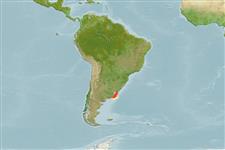
marino demersal; oceanodromo (Ref. 51243); rango de profundidad 1 - 150 m (Ref. 114953). Subtropical; 24°S - 41°S, 63°W - 55°W (Ref. 114953)
Western South Atlantic: From Rio de Janeiro to Argentina.
Tamaño / Peso / Edad
Madurez: Lm ? range ? - ? cm
Max length : 138 cm TL macho / no sexado; (Ref. 57911); common length : 60.0 cm TL macho / no sexado; (Ref. 6077)
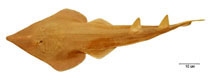
Nostrils are longer, crown is flat transversely or even slightly convex, tubercles in median row are larger, thorn like, numerous. Origin of first dorsal is posterior to the tips of pelvic fins, equal to the base of first dorsal. Upper surface uniform olive gray or chocolate brown, without pale or dark markings. Snout with an oval sooty patch (Ref. 6902).
Body shape (shape guide): elongated.
Found from the coast line to the continental edge. Females mature at ca. 90 cm TL (Ref. 114953). Feeds on crustaceans, cephalopods, polychaetes and small fishes. Ovoviviparous (Ref. 50449). Produces litters of 4-12 pups (Ref. 114953).
Ciclo vital y comportamiento de apareamiento
Madurez | Reproducción | Puesta | Huevos | Fecundidad | Larva
Exhibit ovoviparity (aplacental viviparity), with embryos feeding initially on yolk, then receiving additional nourishment from the mother by indirect absorption of uterine fluid enriched with mucus, fat or protein through specialised structures (Ref. 50449).
Compagno, L.J.V., 1999. Checklist of living elasmobranchs. p. 471-498. In W.C. Hamlett (ed.) Sharks, skates, and rays: the biology of elasmobranch fishes. Johns Hopkins University Press, Maryland. (Ref. 35766)
Situación en la Lista Roja de la UICN (Ref. 130435: Version 2025-2 (Global))
Amenaza para el ser humano
Harmless
Usos humanos
Pesquerías: comercial
Herramientas
Informes especiales
Descargar XML
Fuentes de Internet
Estimaciones basadas en modelos
Temperatura preferida (Referencia
123201): 11.6 - 22.7, mean 15.6 °C (based on 248 cells).
Índice de diversidad filogenética (Referencia
82804): PD
50 = 0.5020 [Uniqueness, from 0.5 = low to 2.0 = high].
Bayesian length-weight: a=0.00282 (0.00134 - 0.00591), b=3.12 (2.95 - 3.29), in cm total length, based on LWR estimates for this Genus-body shape (Ref.
93245).
Nivel trófico (Referencia
69278): 3.8 ±0.49 se; based on food items.
Resiliencia (Referencia
120179): Muy bajo, población duplicada en un tiempo mínimo superior a 14 años (Fec=4-12).
Vulnerabilidad pesquera (Ref.
59153): Very high vulnerability (83 of 100).
🛈