Entorno: milieu / zona climática / rango de profundidad / gama de distribución
Ecología
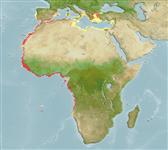
marino; salobre demersal; rango de profundidad 9 - 100 m. Subtropical; 42°N - 19°S, 19°W - 38°E (Ref. 114953)
Eastern Atlantic: northern Portugal to Angola, including the Mediterranean Sea.
Longitud en la primera madurez / Tamaño / Peso / Edad
Madurez: Lm 158.5, range 153 - 164 cm
Max length : 242 cm TL macho / no sexado; (Ref. 40637); common length : 150 cm TL macho / no sexado; (Ref. 3710); peso máximo publicado: 49.9 kg (Ref. 40637)
Descripción breve
Claves de identificación | Morfología | Morfometría
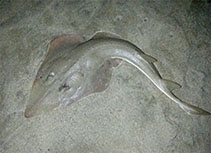
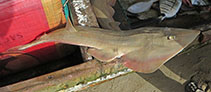
Vértebra: 68 - 73. This large to very large species has a plain beige to brownish wedge-shaped disc; long and rather broad triangular snout with a broadly rounded rostral cartilage at its tip and wide oblique nostrils with a narrow anterior opening; disc thickened centrally, length 1.2-1.3 times its width, anterior margins slightly undulate, often weakly concave before broadly rounded outer corner; snout moderately acute, its angle 59-63°, tip narrowly rounded not extended forward as a distinct lobe; large orbit, length 5-6 times in preorbital length, 1.5-2 in interorbital space; rostral ridges are narrowly separated posteriorly and almost joined anteriorly; 2 fleshy spiracular folds, with innermost fold smaller; upper jaw with 62-72 tooth rows; large and oblique nostrils, its length 1.4 in internasal width, ca 81 nasal lamellae, anterior nasal flaps are confined to anterior margin of nostril; rough skin covered entirely with small denticles; well-developed thorns, usually along edge of rostral cartilage and small patches around orbits and above spiracles; each shoulders with 1-3 thorns that persist in adults, a median row of enlarged thorns extending from nape to first dorsal fin, a few thorns between dorsal fin; long tail ca 1.5 times its disc length; dorsal fins are large and widely spaced, ca. 2.1 times base length of first dorsal fin, apices narrowly rounded; pectoral fin radials 68-73; 204-212 total vertebrae (Ref. 114953).
Body shape (shape guide): elongated.
A coastal and benthic species found on sandy and muddy bottoms, intertidal zone to at least 80 m depth. Feeds mainly on benthic crustaceans and small fishes. Maximum length would probably reach up to 265 cm TL, common at about 200 cm TL. Males mature at 138-154 cm TL, females at 153-164 cm TL. In the Mediterranean Sea, males mature at smaller size, about 100-110 cm TL and females at about 110 cm TL. Size at birth about 34 cm TL. Produces litters up to 20 pups (more common 6-7 pups) (Ref. 114953). Ovoviviparous, one or two litters per year, of 4-6 embryos.
Exhibit ovoviparity (aplacental viviparity), with embryos feeding initially on yolk, then receiving additional nourishment from the mother by indirect absorption of uterine fluid enriched with mucus, fat or protein through specialised structures (Ref. 50449). One or two litters per year, of 4-6 embryos (Ref. 6675).
Bauchot, M.-L., 1987. Raies et autres batoides. p. 845-886. In W. Fischer, M.L. Bauchot and M. Schneider (eds.) Fiches FAO d'identificationpour les besoins de la pêche. (rev. 1). Mèditerranée et mer Noire. Zone de pêche 37. Vol. II. Commission des Communautés Européennes and FAO, Rome. (Ref. 3261)
Situación en la Lista Roja de la UICN (Ref. 130435: Version 2025-2 (Global))
Amenaza para el ser humano
Harmless
Usos humanos
Pesquerías: escaso valor comercial; pesca deportiva: si
Herramientas
Informes especiales
Descargar XML
Fuentes de Internet
Estimaciones basadas en modelos
Temperatura preferida (Referencia
123201): 19.2 - 27.9, mean 25.4 °C (based on 94 cells).
Índice de diversidad filogenética (Referencia
82804): PD
50 = 0.5020 [Uniqueness, from 0.5 = low to 2.0 = high].
Bayesian length-weight: a=0.00347 (0.00143 - 0.00840), b=3.10 (2.89 - 3.31), in cm total length, based on LWR estimates for this (Sub)family-body shape (Ref.
93245).
Nivel trófico (Referencia
69278): 4.0 ±0.70 se; based on food items.
Generation time: 4.0 ( na - na) years. Estimated as median ln(3)/K based on 1
growth studies.
Resiliencia (Referencia
120179): Muy bajo, población duplicada en un tiempo mínimo superior a 14 años (Fec=4).
Vulnerabilidad pesquera (Ref.
59153): High vulnerability (55 of 100).
🛈
Nutrientes (Ref.
124155): Calcium = 17.6 [3.4, 77.4] mg/100g; Iron = 0.666 [0.174, 1.900] mg/100g; Protein = 20.1 [17.9, 22.1] %; Omega3 = 0.226 [0.098, 0.530] g/100g; Selenium = 30.9 [8.2, 84.3] μg/100g; VitaminA = 3.59 [1.33, 9.58] μg/100g; Zinc = 0.457 [0.227, 0.859] mg/100g (wet weight);