sub class Elasmobranchii (ฉลามและกระเบน) (sharks and rays) >
Carcharhiniformes (Ground sharks) >
Carcharhinidae (Requiem sharks)
Etymology: Carcharhinus: karcharos (Gr.), sharp or jagged; rhinus, an ancient name for sharks, from rhine (Gr.), rasp, both words alluding to a shark's jagged, rasp-like skin (See ETYFish); galapagensis: -ensis, Latin suffix denoting place: Galapagos Islands, type locality (See ETYFish).
สิ่งแวดล้อม : สิ่งแวดล้อม / เขตภูมิอากาศ / ระดับความลึก / ระยะการกระจายสินค้า
นิเวศวิทยา
เกี่ยวกับทะเล,น้ำเค็ม เกี่ยวกับหินโสโครก; ระดับความลึก 1 - 286 m (Ref. 58302), usually 30 - 180 m (Ref. 37816). Tropical; 36°N - 34°S, 180°W - 180°E (Ref. 55181)
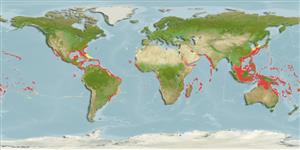
Circumtropical with a preference for waters around oceanic islands. Eastern Atlantic: including St. Paul's Rocks (Refs. 13121, 52289). Western Indian Ocean: including Walter's Shoal, south of Madagascar. Western Pacific: including Middleton and Elizabeth Reefs. Eastern Pacific: Galápagos (Ref. 58896).
ความยาวเมื่อครบกำหนดครั้งแรก / ขนาด / น้ำหนัก / อายุ
วัยเจริญพันธุ์: Lm 230.0, range 215 - 245 cm
Max length : 370 cm TL เพศผู้/กระเทย; (Ref. 1602); common length : 300 cm TL เพศผู้/กระเทย; (Ref. 9253); น้ำหนักสูงสุดที่มีการรายงาน: 85.5 kg (Ref. 40637); อายุสูงสุดที่ได้รายงาน: 24 ปี (Ref. 31395)
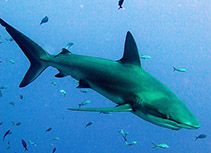
เงี่ยงครีบหลัง (รวม) : 0; เงี่ยงครีบก้น: 0. Low inter-dorsal ridge present (Ref.9997). Dark grey above, light below, fins plain or with slightly dusky tips (Ref. 9997).
Body shape (shape guide): fusiform / normal.
A common but habitat-limited tropical shark found close inshore to well as offshore near or on insular or continental shelves (Ref. 244). Prefers clear water with coral and rocky bottoms (Ref. 244). Although a coastal pelagic species, it is capable of crossing considerable distances of open ocean between islands (at least 50 km) (Ref. 244). Juveniles restricted to shallower water, in 25 m or less (Ref. 244; 37816). Found in superficial aggregations (Ref. 244). Tends to feed near the bottom but may take bait from the surface (Ref. 5485). Feeds mainly on bottom fishes, also squid and octopi (Ref. 244). In the Galapagos Is. it preys on sea lions and marine iguanas (Ref. 28023). Inquisitive and sometimes aggressive, displaying a 'hunch' position ( arched back, raised head and lowered caudal and pectoral fins, while twisting and rolling) near divers that may be followed by biting (Ref. 58085). Viviparous (Ref. 50449). 6 to 16 young of 57 to 80 cm are born per litter (Ref. 1602).
Viviparous, with a yolk sac placenta (Ref. 244). 6 to 16 young born at 60-80 cm (Ref. 26346). Distinct pairing with embrace (Ref. 205).
Compagno, L.J.V., 1984. FAO Species Catalogue. Vol. 4. Sharks of the world. An annotated and illustrated catalogue of shark species known to date. Part 2 - Carcharhiniformes. FAO Fish. Synop. 125(4/2):251-655. Rome: FAO. (Ref. 244)
สถานะบัญชีแดงของ IUCN (Ref. 130435: Version 2025-2 (Global))
ภัยคุกคามต่อมนุษย์
Traumatogenic (Ref. 4690)
การใช้ของมนุษย์
การประมง: มีการค้าเพียงเล็กน้อย; การตกปลาเป็นกีฬา: ใช่
เครื่องมือ
รายงานพิเศษ
ดาวน์โหลด XML
แหล่งที่มาจากอินเตอร์เน็ต
การประมาณค่าตามแบบจำลอง
อุณหภูมิที่ต้องการ (อ้างอิง
123201): 15 - 28.2, mean 23.8 °C (based on 1899 cells).
ดัชนีความหลากหลายทางวิวัฒนาการ (อ้างอิง
82804): PD
50 = 0.5000 [Uniqueness, from 0.5 = low to 2.0 = high].
Bayesian length-weight: a=0.00525 (0.00244 - 0.01130), b=3.07 (2.90 - 3.24), in cm total length, based on LWR estimates for this Genus-body shape (Ref.
93245).
ระดับชั้นอาหาร (อ้างอิง
69278): 4.2 ±0.4 se; based on diet studies.
Generation time: 8.8 ( na - na) years. Estimated as median ln(3)/K based on 1
growth studies.
ความสามารถในการกลับคืนสู่ปกติ (อ้างอิง
120179): ต่ำมาก, เวลาต่ำสุดที่จะทำให้ประชากรเพิ่มขึ้นเป็น 2 เท่าใช้เวลามากกว่า 14 ปี (Fec=4).
ความเสี่ยงต่อการตกปลา (Ref.
59153): High to very high vulnerability (73 of 100).
🛈
สารอาหาร (Ref.
124155): Calcium = 3.97 [0.89, 21.70] mg/100g; Iron = 0.329 [0.083, 0.941] mg/100g; Protein = 22.1 [19.2, 24.4] %; Omega3 = 0.0987 [, ] g/100g; Selenium = 46.8 [14.0, 139.5] μg/100g; VitaminA = 39.1 [13.8, 112.6] μg/100g; Zinc = 0.504 [0.236, 0.958] mg/100g (wet weight);