(كوسه ها و سپرماهيان) (sharks and rays) >
Carcharhiniformes (Ground sharks) >
Carcharhinidae (Requiem sharks)
Etymology: Carcharhinus: karcharos (Gr.), sharp or jagged; rhinus, an ancient name for sharks, from rhine (Gr.), rasp, both words alluding to a shark's jagged, rasp-like skin (See ETYFish); galapagensis: -ensis, Latin suffix denoting place: Galapagos Islands, type locality (See ETYFish).
محیط زیست: محیط زیست / منطقه آب و هوایی / تغييرات عمق / محدوده توزیع
بوم شناسي
دريايي وابسته به آب سنگ; تغييرات عمق 1 - 286 m (Ref. 58302), usually 30 - 180 m (Ref. 37816). Tropical; 36°N - 34°S, 180°W - 180°E (Ref. 55181)
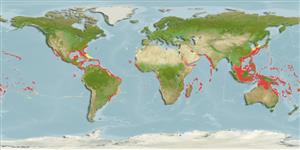
Circumtropical with a preference for waters around oceanic islands. Eastern Atlantic: including St. Paul's Rocks (Refs. 13121, 52289). Western Indian Ocean: including Walter's Shoal, south of Madagascar. Western Pacific: including Middleton and Elizabeth Reefs. Eastern Pacific: Galápagos (Ref. 58896).
طول در اولین بلوغ / اندازه / وزن / سن
بلوغ: Lm 230.0, range 215 - 245 cm
Max length : 370 cm TL جنس نر / بدون خواص جنسي; (Ref. 1602); common length : 300 cm TL جنس نر / بدون خواص جنسي; (Ref. 9253); بيشينه وزن گزارش شده: 85.5 kg (Ref. 40637); بيشينه سن گزارش شده: 24 سال ها (Ref. 31395)
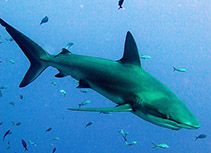
خارهاي باله پشتي (کل) : 0; خارهاي باله مخرجي: 0. Low inter-dorsal ridge present (Ref.9997). Dark grey above, light below, fins plain or with slightly dusky tips (Ref. 9997).
Body shape (shape guide): fusiform / normal.
A common but habitat-limited tropical shark found close inshore to well as offshore near or on insular or continental shelves (Ref. 244). Prefers clear water with coral and rocky bottoms (Ref. 244). Although a coastal pelagic species, it is capable of crossing considerable distances of open ocean between islands (at least 50 km) (Ref. 244). Juveniles restricted to shallower water, in 25 m or less (Ref. 244; 37816). Found in superficial aggregations (Ref. 244). Tends to feed near the bottom but may take bait from the surface (Ref. 5485). Feeds mainly on bottom fishes, also squid and octopi (Ref. 244). In the Galapagos Is. it preys on sea lions and marine iguanas (Ref. 28023). Inquisitive and sometimes aggressive, displaying a 'hunch' position ( arched back, raised head and lowered caudal and pectoral fins, while twisting and rolling) near divers that may be followed by biting (Ref. 58085). Viviparous (Ref. 50449). 6 to 16 young of 57 to 80 cm are born per litter (Ref. 1602).
چرخه زندگی و رفتار جفتگیری
بلوغ | تولید مثل | تخم ریزی | تخم ها | باروری | توزاد ( لارو)
Viviparous, with a yolk sac placenta (Ref. 244). 6 to 16 young born at 60-80 cm (Ref. 26346). Distinct pairing with embrace (Ref. 205).
Compagno, L.J.V., 1984. FAO Species Catalogue. Vol. 4. Sharks of the world. An annotated and illustrated catalogue of shark species known to date. Part 2 - Carcharhiniformes. FAO Fish. Synop. 125(4/2):251-655. Rome: FAO. (Ref. 244)
وضعيت در فهرست قرمز IUCN (Ref. 130435: Version 2025-2 (Global))
خطر برای انسان ها
Traumatogenic (Ref. 4690)
استفاده انسانی
ماهي گيري – شيلات: ارزش تحاري اندك; ماهي ها ي سرگرم كننده: بله
ابزارها
گزارش های ويژه
بارگيری XML
منابع اينترنتي
تخمینها بر اساس مدلها
دمای ترجیحی (مرجع
123201): 15 - 28.2, mean 23.8 °C (based on 1899 cells).
شاخص تنوع فیلوژنتیکی (مرجع
82804): PD
50 = 0.5000 [Uniqueness, from 0.5 = low to 2.0 = high].
Bayesian length-weight: a=0.00525 (0.00244 - 0.01130), b=3.07 (2.90 - 3.24), in cm total length, based on LWR estimates for this Genus-body shape (Ref.
93245).
سطح تروفیک (مرجع
69278): 4.2 ±0.4 se; based on diet studies.
Generation time: 8.8 ( na - na) years. Estimated as median ln(3)/K based on 1
growth studies.
جهندگی (مرجع
120179): خیلی آهسته, كمينه زمان لازم براي دو برابر شدن جمعيت بيش از 14 سال (Fec=4).
آسیبپذیری ماهیگیری (Ref.
59153): High to very high vulnerability (73 of 100).
🛈
مواد مغذی (Ref.
124155): Calcium = 3.97 [0.89, 21.70] mg/100g; Iron = 0.329 [0.083, 0.941] mg/100g; Protein = 22.1 [19.2, 24.4] %; Omega3 = 0.0987 [, ] g/100g; Selenium = 46.8 [14.0, 139.5] μg/100g; VitaminA = 39.1 [13.8, 112.6] μg/100g; Zinc = 0.504 [0.236, 0.958] mg/100g (wet weight);