>
Anguilliformes (Eels and morays) >
Muraenidae (Moray eels) > Muraeninae
Etymology: Rhinomuraena: Greek, rhinos = nose + Latin, muraena = morey eel (Ref. 45335).
More on author: Garman.
Entorno: milieu / zona climática / rango de profundidad / gama de distribución
Ecología
marino asociado a arrecife; no migratorio; rango de profundidad 1 - 67 m (Ref. 90102). Tropical; 32°N - 26°S
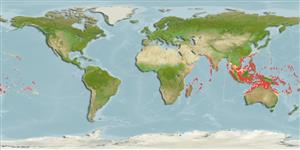
Indo-Pacific: East Africa to the Tuamoto Islands, north to southern Japan, south to New Caledonia and French Polynesia; including Marianas and Marshalls.
Longitud en la primera madurez / Tamaño / Peso / Edad
Madurez: Lm 107.0, range 94 - 120 cm
Max length : 130 cm TL macho / no sexado; (Ref. 2334)
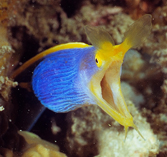
Espinas dorsales (total) : 0; Espinas anales: 0; Vértebra: 270 - 286. Has three fleshy tentacles on the tip of its lower jaw, a single fleshy pointed projection at the tip of its snout, and tubular anterior nostrils ending in gaudy, fanlike expansions.
Body shape (shape guide): eel-like.
Adults occur in lagoon and seaward reefs. They are secretive species normally hidden in sand or rubble, sometimes with only its head protruding. Feed on small fishes (Ref. 9710, 48635, 75154, 89972). Juveniles all black, males have yellow dorsal fin and females change to a nearly all yellow color, but usually with blue in the posterior (Ref. 48635). Only moray that undergoes abrupt changes in coloration and sex: it is a protandrous hermaphrodite, i.e., functioning males reverse sex to become females. Protandry is diagnosed based on colouration, but not confirmed (Ref. 103751).
Ciclo vital y comportamiento de apareamiento
Madurez | Reproducción | Puesta | Huevos | Fecundidad | Larva
Protandry is diagnosed based on colouration, but not confirmed (Ref. 103751).
Chen, H.-M., K.-T. Shao and C.T. Chen, 1994. A review of the muraenid eels (Family Muraenidae) from Taiwan with descriptions of twelve new records. Zool. Stud. 33(1):44-64. (Ref. 6934)
Situación en la Lista Roja de la UICN (Ref. 130435: Version 2025-2 (Global))
Amenaza para el ser humano
Harmless
Usos humanos
Pesquerías: comercial; Acuario: Comercial
Herramientas
Informes especiales
Descargar XML
Fuentes de Internet
Estimaciones basadas en modelos
Temperatura preferida (Referencia
123201): 24.6 - 28.8, mean 27.5 °C (based on 552 cells).
Índice de diversidad filogenética (Referencia
82804): PD
50 = 1.0000 [Uniqueness, from 0.5 = low to 2.0 = high].
Bayesian length-weight: a=0.00049 (0.00024 - 0.00099), b=3.26 (3.09 - 3.43), in cm total length, based on LWR estimates for this (Sub)family-body shape (Ref.
93245).
Nivel trófico (Referencia
69278): 4.5 ±0.80 se; based on food items.
Resiliencia (Referencia
120179): Muy bajo, población duplicada en un tiempo mínimo superior a 14 años (Preliminary K or Fecundity.).
Vulnerabilidad pesquera (Ref.
59153): Very high vulnerability (78 of 100).
🛈
Nutrientes (Ref.
124155): Calcium = 22.6 [12.0, 35.3] mg/100g; Iron = 0.436 [0.257, 0.889] mg/100g; Protein = 18.8 [16.6, 21.4] %; Omega3 = 0.102 [0.046, 0.293] g/100g; Selenium = 49.2 [25.9, 97.7] μg/100g; VitaminA = 86.8 [25.0, 291.3] μg/100g; Zinc = 0.721 [0.498, 1.001] mg/100g (wet weight);