>
Anguilliformes (Eels and morays) >
Muraenidae (Moray eels) > Muraeninae
Etymology: Rhinomuraena: Greek, rhinos = nose + Latin, muraena = morey eel (Ref. 45335).
More on author: Garman.
Ambiente: milieu / zona climatica / distribuzione batimetrica / gamma di distribuzione
Ecologia
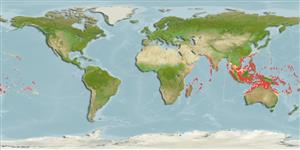
marino associati a barriera corallina; non migratori; distribuzione batimetrica 1 - 67 m (Ref. 90102). Tropical; 32°N - 26°S
Indo-Pacific: East Africa to the Tuamoto Islands, north to southern Japan, south to New Caledonia and French Polynesia; including Marianas and Marshalls.
Lunghezza alla prima maturità / Dimensione / Peso / Età
Maturità: Lm 107.0, range 94 - 120 cm
Max length : 130 cm TL maschio/sesso non determinato; (Ref. 2334)
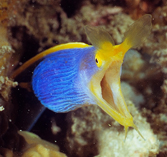
Spine dorsali (totale) : 0; Spine anali: 0; Vertebre: 270 - 286. Has three fleshy tentacles on the tip of its lower jaw, a single fleshy pointed projection at the tip of its snout, and tubular anterior nostrils ending in gaudy, fanlike expansions.
Body shape (shape guide): eel-like.
Adults occur in lagoon and seaward reefs. They are secretive species normally hidden in sand or rubble, sometimes with only its head protruding. Feed on small fishes (Ref. 9710, 48635, 75154, 89972). Juveniles all black, males have yellow dorsal fin and females change to a nearly all yellow color, but usually with blue in the posterior (Ref. 48635). Only moray that undergoes abrupt changes in coloration and sex: it is a protandrous hermaphrodite, i.e., functioning males reverse sex to become females. Protandry is diagnosed based on colouration, but not confirmed (Ref. 103751).
Ciclo vitale e comportamento di accoppiamento
Maturità | Riproduzione | Deposizione | Uova | Fecondità | Larve
Protandry is diagnosed based on colouration, but not confirmed (Ref. 103751).
Chen, H.-M., K.-T. Shao and C.T. Chen, 1994. A review of the muraenid eels (Family Muraenidae) from Taiwan with descriptions of twelve new records. Zool. Stud. 33(1):44-64. (Ref. 6934)
Stato della Lista Rossa IUCN (Ref. 130435: Version 2025-2 (Global))
Minaccia per l'uomo
Harmless
Usi umani
Pesca: commerciale; Acquario: Commerciale
Strumenti
Rapporti speciali
Scarica XML
Fonti Internet
Stime basate su modelli
Temperatura preferita (Fonte Biblio.
123201): 24.6 - 28.8, mean 27.5 °C (based on 552 cells).
Indice di diversità filogenetica (Fonte Biblio.
82804): PD
50 = 1.0000 [Uniqueness, from 0.5 = low to 2.0 = high].
Bayesian length-weight: a=0.00049 (0.00024 - 0.00099), b=3.26 (3.09 - 3.43), in cm total length, based on LWR estimates for this (Sub)family-body shape (Ref.
93245).
Livello trofico (Fonte Biblio.
69278): 4.5 ±0.80 se; based on food items.
Resilienza (Fonte Biblio.
120179): Molto basso, tempo minimo di raddoppiamento della popolazione più di 14 anni (Preliminary K or Fecundity.).
Vulnerabilità della pesca (Ref.
59153): Very high vulnerability (78 of 100).
🛈
Nutrienti (Ref.
124155): Calcium = 22.6 [12.0, 35.3] mg/100g; Iron = 0.436 [0.257, 0.889] mg/100g; Protein = 18.8 [16.6, 21.4] %; Omega3 = 0.102 [0.046, 0.293] g/100g; Selenium = 49.2 [25.9, 97.7] μg/100g; VitaminA = 86.8 [25.0, 291.3] μg/100g; Zinc = 0.721 [0.498, 1.001] mg/100g (wet weight);