sub class Elasmobranchii (ฉลามและกระเบน) (sharks and rays) >
Carcharhiniformes (Ground sharks) >
Pentanchidae (Deepwater catsharks)
Etymology: Holohalaelurus: holos (Gr.), whole or entire, i.e., being a form of Halaeurus without any labial folds or grooves in the mouth (See ETYFish); punctatus: Latin for spotted, referring to dense covering of small brown spots on dorsal surface (See ETYFish).
สิ่งแวดล้อม : สิ่งแวดล้อม / เขตภูมิอากาศ / ระดับความลึก / ระยะการกระจายสินค้า
นิเวศวิทยา
เกี่ยวกับทะเล,น้ำเค็ม สัตว์หน้าดินในเขตน้ำลึก; ระดับความลึก 220 - 440 m (Ref. 5510). Deep-water; 4°S - 37°S
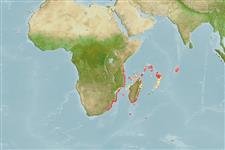
Western Indian Ocean: endemic to the subtropical and tropical waters of southwestern Indian Ocean, southern Mozambique, off Natal, South Africa and off Madagascar (Ref. 75585).
Status of threat: a common catch in bottom trawls in Natal and southern Mozambique, yet, despite recent biodiversity trawl surveys in that region, not a single specimen has been collected from this area since 1972. ORI data sheets confirm that specimens collected between 1964 and 1972 were apparently abundant, particularly off Mozambique in May 1969, and off Durban in June 1971. The only specimens of this species that have been collected since this date have been those from Madagascar in the late 1980’s and early 1990’s (Ref. 75585).
ความยาวเมื่อครบกำหนดครั้งแรก / ขนาด / น้ำหนัก / อายุ
วัยเจริญพันธุ์: Lm 31.2, range 30 - 32.6 cm
Max length : 35.0 cm TL เพศผู้/กระเทย; (Ref. 5510); 26.0 cm TL (female)
คำอธิบายสั้นๆ
เครื่องมือที่ใช้ในการแยกชนิดสัตว์,สิ่งมีชีวิตออกจากกัน | สัณฐานวิทยา | ความยาวต่างๆ
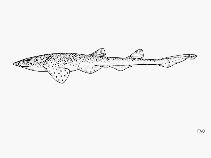
เงี่ยงครีบหลัง (รวม) : 0; เงี่ยงครีบก้น: 0. A broad-headed, dwarf catshark with small dark brown spots closely set on a yellow-brown or orange-brown background; small black pores on underside of head and body; no labial furrows (Ref. 5578).
Body shape (shape guide): elongated.
Found on the uppermost continental slopes (Ref. 244). Feeds on small fishes, crustaceans, and cephalopods (Ref. 5213). The adult males are larger than females, a characteristic unusual among sharks (Ref. 244). Manifests partial sexual segregation. Oviparous (Ref. 50449).
วงจรชีวิตและพฤติกรรมการผสมพันธุ์
วัยเจริญพันธุ์ | การสืบพันธุ์ | การวางไข่ | เซลสืบพันธ์ของเพศเมีย(ไข่) | ความดกของไข่ | ตัวอ่อน
Oviparous, with one egg-case laid per oviduct at a time. Embryos feed solely on yolk (Ref. 50449). Partial sexual segregation is manifested by greater number of males than females off Natal but not off southern Mozambique.
Compagno, L.J.V., 1984. FAO Species Catalogue. Vol. 4. Sharks of the world. An annotated and illustrated catalogue of shark species known to date. Part 2 - Carcharhiniformes. FAO Fish. Synop. 125(4/2):251-655. Rome: FAO. (Ref. 244)
สถานะบัญชีแดงของ IUCN (Ref. 130435: Version 2025-2 (Global))
ภัยคุกคามต่อมนุษย์
Harmless
การใช้ของมนุษย์
การประมง: ไม่มีผลประโยชน์
เครื่องมือ
รายงานพิเศษ
ดาวน์โหลด XML
แหล่งที่มาจากอินเตอร์เน็ต
การประมาณค่าตามแบบจำลอง
อุณหภูมิที่ต้องการ (อ้างอิง
123201): 13.1 - 15.8, mean 15.3 °C (based on 13 cells).
ดัชนีความหลากหลายทางวิวัฒนาการ (อ้างอิง
82804): PD
50 = 0.5312 [Uniqueness, from 0.5 = low to 2.0 = high].
Bayesian length-weight: a=0.00347 (0.00172 - 0.00698), b=3.08 (2.90 - 3.26), in cm total length, based on LWR estimates for this (Sub)family-body shape (Ref.
93245).
ระดับชั้นอาหาร (อ้างอิง
69278): 4.2 ±0.61 se; based on food items.
ความสามารถในการกลับคืนสู่ปกติ (อ้างอิง
120179): ต่ำ, เวลาต่ำสุดที่จะทำให้ประชากรเพิ่มขึ้นเป็น 2 เท่าใช้เวลา 4.5 - 14 ปี (Fec assumed to be <100).
ความเสี่ยงต่อการตกปลา (Ref.
59153): Low vulnerability (25 of 100).
🛈