Elasmobranchi (squali e razze) (sharks and rays) >
Carcharhiniformes (Ground sharks) >
Pentanchidae (Deepwater catsharks)
Etymology: Holohalaelurus: holos (Gr.), whole or entire, i.e., being a form of Halaeurus without any labial folds or grooves in the mouth (See ETYFish); punctatus: Latin for spotted, referring to dense covering of small brown spots on dorsal surface (See ETYFish).
Ambiente: milieu / zona climatica / distribuzione batimetrica / gamma di distribuzione
Ecologia
marino batidemersale; distribuzione batimetrica 220 - 440 m (Ref. 5510). Deep-water; 4°S - 37°S
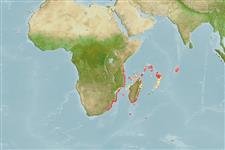
Western Indian Ocean: endemic to the subtropical and tropical waters of southwestern Indian Ocean, southern Mozambique, off Natal, South Africa and off Madagascar (Ref. 75585).
Status of threat: a common catch in bottom trawls in Natal and southern Mozambique, yet, despite recent biodiversity trawl surveys in that region, not a single specimen has been collected from this area since 1972. ORI data sheets confirm that specimens collected between 1964 and 1972 were apparently abundant, particularly off Mozambique in May 1969, and off Durban in June 1971. The only specimens of this species that have been collected since this date have been those from Madagascar in the late 1980’s and early 1990’s (Ref. 75585).
Lunghezza alla prima maturità / Dimensione / Peso / Età
Maturità: Lm 31.2, range 30 - 32.6 cm
Max length : 35.0 cm TL maschio/sesso non determinato; (Ref. 5510); 26.0 cm TL (female)
Breve descrizione
Chiavi di identificazione | Morfologia | Morfometria
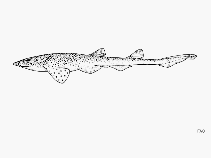
Spine dorsali (totale) : 0; Spine anali: 0. A broad-headed, dwarf catshark with small dark brown spots closely set on a yellow-brown or orange-brown background; small black pores on underside of head and body; no labial furrows (Ref. 5578).
Body shape (shape guide): elongated.
Found on the uppermost continental slopes (Ref. 244). Feeds on small fishes, crustaceans, and cephalopods (Ref. 5213). The adult males are larger than females, a characteristic unusual among sharks (Ref. 244). Manifests partial sexual segregation. Oviparous (Ref. 50449).
Ciclo vitale e comportamento di accoppiamento
Maturità | Riproduzione | Deposizione | Uova | Fecondità | Larve
Oviparous, with one egg-case laid per oviduct at a time. Embryos feed solely on yolk (Ref. 50449). Partial sexual segregation is manifested by greater number of males than females off Natal but not off southern Mozambique.
Compagno, L.J.V., 1984. FAO Species Catalogue. Vol. 4. Sharks of the world. An annotated and illustrated catalogue of shark species known to date. Part 2 - Carcharhiniformes. FAO Fish. Synop. 125(4/2):251-655. Rome: FAO. (Ref. 244)
Stato della Lista Rossa IUCN (Ref. 130435: Version 2025-2 (Global))
Minaccia per l'uomo
Harmless
Usi umani
Pesca: di nessun interesse
Strumenti
Fatal error: Uncaught mysqli_sql_exception: Too many connections in /var/www/html/includes/speciessummary.lib.php:1888
Stack trace:
#0 /var/www/html/includes/speciessummary.lib.php(1888): mysqli->__construct('mysql', 'fbuser', Object(SensitiveParameterValue), 'fbquizv2', '3306')
#1 /var/www/html/summary/SpeciesSummary.php(1851): checkRecordDisplayFBQuizV2('828', 'PicList')
#2 {main}
thrown in /var/www/html/includes/speciessummary.lib.php on line 1888