Ambiente: milieu / zona climatica / distribuzione batimetrica / gamma di distribuzione
Ecologia
marino demersale; distribuzione batimetrica 1 - 50 m (Ref. 118646). Tropical; 31°N - 10°S, 115°W - 77°W (Ref. 5222)
Eastern Pacific: Baja California, Mexico to Peru, including the offshore islands of Cocos, Revillagigedo, and the Galapagos Islands.
Dimensione / Peso / Età
Maturità: Lm ? range ? - ? cm
Max length : 60.0 cm TL maschio/sesso non determinato; (Ref. 11035)
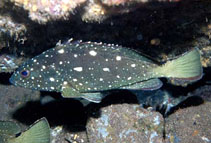
Spine dorsali (totale) : 11; Raggi dorsali molli (totale) : 16 - 18; Spine anali: 3; Raggi anali molli: 8. Distinguished by the following characteristics: olive green to reddish brown with scattered irregular white and brown spots and blotches; white triangle at the margin of the interspinous dorsal-fin membranes and bright white tag at the tip of each spine; juveniles with black spots on the top of head and median fins reddish distally with white edge; small black saddle on peduncle; inside of mouth is red; depth of body contained 2.7-3.1 times in SL; head length 2.2-2.5 times in SL; flat interorbital area; rounded preopercle, finely serrate, slightly enlarged ventral serrae; smooth subopercle and interopercle; slightly convex upper edge of operculum; subequal anterior and posterior nostrils (Ref. 89707).
Body shape (shape guide): fusiform / normal; Cross section: compressed.
Adults are most abundant in shallow water and also occurs to a depth of at least 30 m. Inhabits rocky area of coastal waters within continental shelf (Ref. 11035). A solitary predator that seems to feed on smaller fishes by day and crustaceans after dark. Spawning occurs in late summer (Ref. 5592).
Ciclo vitale e comportamento di accoppiamento
Maturità | Riproduzione | Deposizione | Uova | Fecondità | Larve
Heemstra, P.C. and J.E. Randall, 1993. FAO Species Catalogue. Vol. 16. Groupers of the world (family Serranidae, subfamily Epinephelinae). An annotated and illustrated catalogue of the grouper, rockcod, hind, coral grouper and lyretail species known to date. Rome: FAO. FAO Fish. Synop. 125(16):382 p. (Ref. 5222)
Stato della Lista Rossa IUCN (Ref. 130435: Version 2025-2 (Global))
Minaccia per l'uomo
Harmless
Usi umani
Pesca: scarso interesse commerciale; Pesce da pesca sportiva: si
Strumenti
Rapporti speciali
Scarica XML
Fonti Internet
Stime basate su modelli
Indice di diversità filogenetica (Fonte Biblio.
82804): PD
50 = 0.5000 [Uniqueness, from 0.5 = low to 2.0 = high].
Bayesian length-weight: a=0.01549 (0.00943 - 0.02544), b=3.04 (2.90 - 3.18), in cm total length, based on LWR estimates for this species & Genus-body shape (Ref.
93245).
Livello trofico (Fonte Biblio.
69278): 4.0 ±0.66 se; based on food items.
Generation time: 5.1 ( na - na) years. Estimated as median ln(3)/K based on 2
growth studies.
Resilienza (Fonte Biblio.
120179): Basso, tempo minimo di raddoppiamento della popolazione 4.5 - 14 anni (tmax=23; k=0.25).
Vulnerabilità della pesca (Ref.
59153): Moderate vulnerability (40 of 100).
🛈
Nutrienti (Ref.
124155): Calcium = 82.6 [36.9, 183.2] mg/100g; Iron = 0.899 [0.433, 2.069] mg/100g; Protein = 17.8 [16.2, 19.4] %; Omega3 = 0.195 [0.099, 0.349] g/100g; Selenium = 53.7 [26.7, 122.7] μg/100g; VitaminA = 45.4 [11.0, 184.3] μg/100g; Zinc = 1.22 [0.78, 1.97] mg/100g (wet weight);