Environnement : milieu / zone climatique / profondeur / gamme de distribution
Écologie
marin démersal; profondeur 1 - 50 m (Ref. 118646). Tropical; 31°N - 10°S, 115°W - 77°W (Ref. 5222)
Eastern Pacific: Baja California, Mexico to Peru, including the offshore islands of Cocos, Revillagigedo, and the Galapagos Islands.
Taille / Poids / Âge
Maturité: Lm ? range ? - ? cm
Max length : 60.0 cm TL mâle / non sexé; (Ref. 11035)
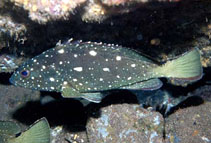
Épines dorsales (Total) : 11; Rayons mous dorsaux (Total) : 16 - 18; Épines anales: 3; Rayons mous anaux: 8. Distinguished by the following characteristics: olive green to reddish brown with scattered irregular white and brown spots and blotches; white triangle at the margin of the interspinous dorsal-fin membranes and bright white tag at the tip of each spine; juveniles with black spots on the top of head and median fins reddish distally with white edge; small black saddle on peduncle; inside of mouth is red; depth of body contained 2.7-3.1 times in SL; head length 2.2-2.5 times in SL; flat interorbital area; rounded preopercle, finely serrate, slightly enlarged ventral serrae; smooth subopercle and interopercle; slightly convex upper edge of operculum; subequal anterior and posterior nostrils (Ref. 89707).
Body shape (shape guide): fusiform / normal; Cross section: compressed.
Adults are most abundant in shallow water and also occurs to a depth of at least 30 m. Inhabits rocky area of coastal waters within continental shelf (Ref. 11035). A solitary predator that seems to feed on smaller fishes by day and crustaceans after dark. Spawning occurs in late summer (Ref. 5592).
Cycle de vie et comportement reproducteur
Maturité | Reproduction | Frai | Œufs | Fécondité | Larves
Heemstra, P.C. and J.E. Randall, 1993. FAO Species Catalogue. Vol. 16. Groupers of the world (family Serranidae, subfamily Epinephelinae). An annotated and illustrated catalogue of the grouper, rockcod, hind, coral grouper and lyretail species known to date. Rome: FAO. FAO Fish. Synop. 125(16):382 p. (Ref. 5222)
Statut dans la liste rouge de l'IUCN (Ref. 130435: Version 2025-2 (Global))
Menace pour l'homme
Harmless
Utilisations par l'homme
Pêcheries: intérêt commercial mineur; pêche sportive: oui
Outils
Articles particuliers
Télécharger en XML
Sources Internet
Estimations basées sur des modèles
Indice de diversité phylogénétique (Réf.
82804): PD
50 = 0.5000 [Uniqueness, from 0.5 = low to 2.0 = high].
Bayesian length-weight: a=0.01549 (0.00943 - 0.02544), b=3.04 (2.90 - 3.18), in cm total length, based on LWR estimates for this species & Genus-body shape (Ref.
93245).
Niveau trophique (Réf.
69278): 4.0 ±0.66 se; based on food items.
Generation time: 5.1 ( na - na) years. Estimated as median ln(3)/K based on 2
growth studies.
Résilience (Réf.
120179): Faible, temps minimum de doublement de population : 4,5 à 14 années (tmax=23; k=0.25).
Vulnérabilité de la pêche (Ref.
59153): Moderate vulnerability (40 of 100).
🛈
Nutriments (Ref.
124155): Calcium = 82.6 [36.9, 183.2] mg/100g; Iron = 0.899 [0.433, 2.069] mg/100g; Protein = 17.8 [16.2, 19.4] %; Omega3 = 0.195 [0.099, 0.349] g/100g; Selenium = 53.7 [26.7, 122.7] μg/100g; VitaminA = 45.4 [11.0, 184.3] μg/100g; Zinc = 1.22 [0.78, 1.97] mg/100g (wet weight);