Élasmobranches (requins et raies) (sharks and rays) >
Carcharhiniformes (Ground sharks) >
Pentanchidae (Deepwater catsharks)
Etymology: Galeus: galeos, a small shark or dogfish according to Aristotle and others (See ETYFish); eastmani: Patronym not identified, probably in honor of American geologist and paleontologist Charles Rochester Eastman (1868-1918), a specialist in fossil fishes (See ETYFish).
Eponymy: Dr Charles Rochester Eastman (1868–1918) was an American palaeontologist, particularly interested in fossil fish. [...] (Ref. 128868), visit book page.
More on authors: Jordan & Snyder.
Environnement : milieu / zone climatique / profondeur / gamme de distribution
Écologie
marin bathydémersal. Deep-water; 34°N -
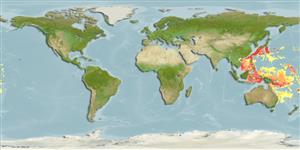
Northwestern Pacific: Japan to Taiwan (Ref. 127969). Possibly Vietnam and Malaysia.
Longueur à la première maturité / Taille / Poids / Âge
Maturité: Lm 36.5, range 36 - 37 cm
Max length : 40.0 cm TL mâle / non sexé; (Ref. 11146)
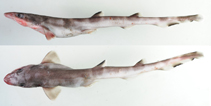
Épines dorsales (Total) : 0; Épines anales: 0. Obscure saddle markings on body and precaudal tail, and with dark markings on the terminal and hypural caudal-fin lobes (Ref. 11146).
Body shape (shape guide): elongated.
A little-known, but very common shark, found in deep water near the bottom (Ref. 11146). Maximum length of at least 40 cm TL, probably reaching 50 cm (Ref. 11146).
Cycle de vie et comportement reproducteur
Maturité | Reproduction | Frai | Œufs | Fécondité | Larves
Oviparous, with a single egg laid per oviduct (Ref. 244). Embryos feed solely on yolk (Ref. 50449).
Compagno, L.J.V., 1984. FAO Species Catalogue. Vol. 4. Sharks of the world. An annotated and illustrated catalogue of shark species known to date. Part 2 - Carcharhiniformes. FAO Fish. Synop. 125(4/2):251-655. Rome: FAO. (Ref. 244)
Statut dans la liste rouge de l'IUCN (Ref. 130435: Version 2025-2 (Global))
Menace pour l'homme
Harmless
Utilisations par l'homme
Pêcheries: intérêt commercial mineur
Outils
Articles particuliers
Télécharger en XML
Sources Internet
Estimations basées sur des modèles
Température préférée (Réf.
123201): 2.6 - 5.8, mean 3.8 °C (based on 706 cells).
Indice de diversité phylogénétique (Réf.
82804): PD
50 = 0.5000 [Uniqueness, from 0.5 = low to 2.0 = high].
Bayesian length-weight: a=0.00347 (0.00172 - 0.00698), b=3.08 (2.90 - 3.26), in cm total length, based on LWR estimates for this (Sub)family-body shape (Ref.
93245).
Niveau trophique (Réf.
69278): 3.9 ±0.2 se; based on diet studies.
Résilience (Réf.
120179): Faible, temps minimum de doublement de population : 4,5 à 14 années (Fec assumed to be <100).
Vulnérabilité de la pêche (Ref.
59153): Low to moderate vulnerability (30 of 100).
🛈
Nutriments (Ref.
124155): Calcium = 11.3 [2.0, 74.3] mg/100g; Iron = 0.364 [0.077, 1.246] mg/100g; Protein = 16.8 [13.6, 19.9] %; Omega3 = 0.214 [0.087, 0.521] g/100g; Selenium = 6.88 [2.12, 20.95] μg/100g; VitaminA = 21.6 [4.6, 104.1] μg/100g; Zinc = 0.449 [0.208, 0.865] mg/100g (wet weight);