इलाज़मौबरांकी (शारक और रेज़) (sharks and rays) >
Myliobatiformes (Stingrays) >
Rhinopteridae (Cownose rays)
Etymology: Rhinoptera: Greek, rhinos = nose + Greek,pteron = fin, wing (Ref. 45335).
More on authors: Müller & Henle.
पर्यावरण: पर्यावरण / जलवायु क्षेत्र / गहराई सीमा / वितरण सीमा
पारिस्थितिकी
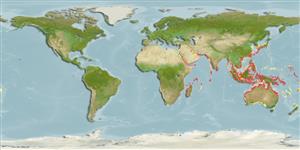
समुद्री; खारा प्रवाल-भित्ति संयुक्त. Tropical; 30°N - 15°S, 55°E - 135°E (Ref. 114953)
Indo-West Pacific: Oman to the Philippines; north to Ryukyu Is.; south to eastern Indonesia.
आकार / वज़न / आयु
परिपक्व अवधि: Lm ? range ? - ? cm
Max length : 165 cm WD पुल्लिंग / अलिंग; (Ref. 114953); अधिकतम प्रकाशित वज़न: 4.5 kg (Ref. 3965)
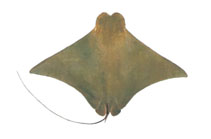
Double-lobed snout and indented forehead; jaws usually with 7 rows of plate-like teeth; no caudal fin (Ref. 5578). Brown above, white below (Ref. 5578).
Body shape (shape guide): other.
Found in bays, estuaries, and near coral reefs (Ref. 12951), over sand and mud bottoms (Ref. 9710). Usually solitary or in small aggregations (Ref. 114953). However, large schools with up to 500 individuals have been reported (Ref. 12951). Feeds on clams, oysters and crustaceans (Ref. 12951). Lives to over 2 years in captivity (Ref. 12951). Ovoviviparous (Ref. 50449). Edible (Ref. 30573). Caught mainly by gill net fisheries (Ref. 114953), occasionally by bottom trawl, demersal inshore gillnet and tangle net fisheries. Utilized for its meat (Ref. 58048).
जीवन चक्र और संभोग व्यवहार
परिपक्व अवधि | पुनरुत्पत्ति | मछलीऔ का अंडे देना | अंडे | उपजाऊपन | लार्वा
Males court by nipping the female's dorsum. Mating pair orient in a venter to venter position, and the male inserts one or both claspers. The pair usually rests on the substrate, with the female on top of the male. Mating lasts about 30 seconds (Ref. 12951) to 1 minute (Ref. 49562). Exhibit ovoviparity (aplacental viviparity), with embryos feeding initially on yolk, then receiving additional nourishment from the mother by indirect absorption of uterine fluid enriched with mucus, fat or protein through specialised structures (Ref. 50449). Size at birth ~60 cm WD. One large pregnant female (~130 cm WD) contained a single late-term embryo 61 cm WD (Ref.58048).
Last, P.R., W.T. White, M.R. de Carvalho, B. Séret, M.F.W. Stehmann and G.J.P. Naylor, 2016. Rays of the world. CSIRO Publishing, Comstock Publishing Associates. i-ix + 1-790. (Ref. 114953)
आईयूसीएन रेड लिस्ट स्थिति (Ref. 130435: Version 2025-2 (Global))
मानव उपयोग
मात्स्यिकी: व्यापारिक; आखेट मत्स्य: हां
साधन
विशेष रिपोर्ट
XML डाउनलोड करें
इंटरनेट स्रोत
मॉडल पर आधारित अनुमान
पसंदीदा तापमान (संदर्भ
123201): 24.2 - 29.2, mean 28.4 °C (based on 3123 cells).
जातिवृति विविधता सूचकांक (संदर्भ
82804): PD
50 = 0.5156 [Uniqueness, from 0.5 = low to 2.0 = high].
Bayesian length-weight: a=0.01122 (0.00641 - 0.01964), b=2.94 (2.78 - 3.10), in cm total length, based on LWR estimates for this species & (Sub)family-body (Ref.
93245).
ट्रॉफिक स्तर (संदर्भ
69278): 3.5 ±0.24 se; based on food items.
लौटाव (संदर्भ
120179): बहुत नीचे, न्यूनतम जनसंख्या दुगनी समय अवलागत 14 महीने। (Fec=1-2).
मछली पकड़ने की भेद्यता (Ref.
59153): Very high vulnerability (83 of 100).
🛈
पोषक तत्व (Ref.
124155): Calcium = 5.55 [0.68, 83.89] mg/100g; Iron = 0.366 [0.030, 4.005] mg/100g; Protein = 20.9 [15.6, 26.2] %; Omega3 = 0.0676 [, ] g/100g; Selenium = 30.8 [5.7, 156.0] μg/100g; VitaminA = 18.7 [1.7, 205.1] μg/100g; Zinc = 0.824 [0.056, 9.302] mg/100g (wet weight);