Élasmobranches (requins et raies) (sharks and rays) >
Myliobatiformes (Stingrays) >
Rhinopteridae (Cownose rays)
Etymology: Rhinoptera: Greek, rhinos = nose + Greek,pteron = fin, wing (Ref. 45335).
More on authors: Müller & Henle.
Environnement : milieu / zone climatique / profondeur / gamme de distribution
Écologie
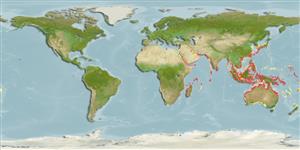
marin; saumâtre récifal. Tropical; 30°N - 15°S, 55°E - 135°E (Ref. 114953)
Indo-West Pacific: Oman to the Philippines; north to Ryukyu Is.; south to eastern Indonesia.
Taille / Poids / Âge
Maturité: Lm ? range ? - ? cm
Max length : 165 cm WD mâle / non sexé; (Ref. 114953); poids max. publié: 4.5 kg (Ref. 3965)
Description synthétique
Clés d'identification | Morphologie | Morphométrie
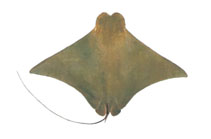
Double-lobed snout and indented forehead; jaws usually with 7 rows of plate-like teeth; no caudal fin (Ref. 5578). Brown above, white below (Ref. 5578).
Body shape (shape guide): other.
Found in bays, estuaries, and near coral reefs (Ref. 12951), over sand and mud bottoms (Ref. 9710). Usually solitary or in small aggregations (Ref. 114953). However, large schools with up to 500 individuals have been reported (Ref. 12951). Feeds on clams, oysters and crustaceans (Ref. 12951). Lives to over 2 years in captivity (Ref. 12951). Ovoviviparous (Ref. 50449). Edible (Ref. 30573). Caught mainly by gill net fisheries (Ref. 114953), occasionally by bottom trawl, demersal inshore gillnet and tangle net fisheries. Utilized for its meat (Ref. 58048).
Cycle de vie et comportement reproducteur
Maturité | Reproduction | Frai | Œufs | Fécondité | Larves
Males court by nipping the female's dorsum. Mating pair orient in a venter to venter position, and the male inserts one or both claspers. The pair usually rests on the substrate, with the female on top of the male. Mating lasts about 30 seconds (Ref. 12951) to 1 minute (Ref. 49562). Exhibit ovoviparity (aplacental viviparity), with embryos feeding initially on yolk, then receiving additional nourishment from the mother by indirect absorption of uterine fluid enriched with mucus, fat or protein through specialised structures (Ref. 50449). Size at birth ~60 cm WD. One large pregnant female (~130 cm WD) contained a single late-term embryo 61 cm WD (Ref.58048).
Last, P.R., W.T. White, M.R. de Carvalho, B. Séret, M.F.W. Stehmann and G.J.P. Naylor, 2016. Rays of the world. CSIRO Publishing, Comstock Publishing Associates. i-ix + 1-790. (Ref. 114953)
Statut dans la liste rouge de l'IUCN (Ref. 130435: Version 2025-2 (Global))
Utilisations par l'homme
Pêcheries: commercial; pêche sportive: oui
Outils
Articles particuliers
Télécharger en XML
Sources Internet
Estimations basées sur des modèles
Température préférée (Réf.
123201): 24.2 - 29.2, mean 28.4 °C (based on 3123 cells).
Indice de diversité phylogénétique (Réf.
82804): PD
50 = 0.5156 [Uniqueness, from 0.5 = low to 2.0 = high].
Bayesian length-weight: a=0.01122 (0.00641 - 0.01964), b=2.94 (2.78 - 3.10), in cm total length, based on LWR estimates for this species & (Sub)family-body (Ref.
93245).
Niveau trophique (Réf.
69278): 3.5 ±0.24 se; based on food items.
Résilience (Réf.
120179): Très faible, temps minimum de doublement de population supérieur à 14 ans (Fec=1-2).
Vulnérabilité de la pêche (Ref.
59153): Very high vulnerability (83 of 100).
🛈
Nutriments (Ref.
124155): Calcium = 5.55 [0.68, 83.89] mg/100g; Iron = 0.366 [0.030, 4.005] mg/100g; Protein = 20.9 [15.6, 26.2] %; Omega3 = 0.0676 [, ] g/100g; Selenium = 30.8 [5.7, 156.0] μg/100g; VitaminA = 18.7 [1.7, 205.1] μg/100g; Zinc = 0.824 [0.056, 9.302] mg/100g (wet weight);