Elasmobranchi (squali e razze) (sharks and rays) >
Torpediniformes (Electric rays) >
Torpedinidae (Electric rays)
Etymology: Torpedo: Latin, torpere = be sluggish (Ref. 45335).
Taxonomic Remarks
Torpedo zugmayeri Engelhardt, 1912 could be a valid species after Weigmann (2016; Ref. 106604) (valid in ECoF, v. Jan. 2021).
Ambiente: milieu / zona climatica / distribuzione batimetrica / gamma di distribuzione
Ecologia
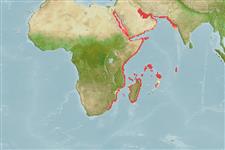
marino; salmastro associati a barriera corallina; distribuzione batimetrica 1 - 200 m (Ref. 9710). Tropical; 30°N - 31°S, 30°E - 72°E (Ref. 114953)
Western Indian Ocean: Persian Gulf (Ref. 80050), Red Sea eastward to India (Ref. 2712) and southward to Natal, South Africa (Ref. 5578).
Dimensione / Peso / Età
Maturità: Lm ? range ? - ? cm
Max length : 130 cm TL maschio/sesso non determinato; (Ref. 2712)
Breve descrizione
Chiavi di identificazione | Morfologia | Morfometria
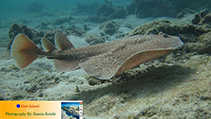
Large ray with a small caudal fin and with papillae around the spiracles (Ref. 5578). Bright color pattern of circles and irregular marks, cream or golden on dark red or brown to blackish background dorsally (Ref. 5578).
Body shape (shape guide): other.
Found inshore in sandy bottoms, and well offshore from the surf zone down to 200 m (Ref. 5578). Also on or near coral reefs (Ref. 12951, Ref. 114953). Common in shallow sandy areas (Ref. 2712). Feeds on bony fishes (Ref. 12951) and benthic invertebrates (Ref. 114953). Ovoviviparous (Ref. 50449). Males mature by 30 cm TL (Ref. 114953). Occurs singly but may form groups during the breeding season (Ref. 12951). Occasionally hooked by anglers, more often seen by divers; can deliver a strong shock (Ref. 2712). Flesh is edible (Ref. 12484). Can survive for hours after being stranded on the beach (Ref. 41394).
Exhibit ovoviparity (aplacental viviparity), with embryos feeding initially on yolk, then receiving additional nourishment from the mother by indirect absorption of uterine fluid enriched with mucus, fat or protein through specialised structures (Ref. 50449). With 9-22 in a litter (Ref. 12951). Form aggregations during the reproductive season (Ref. 41394).
Compagno, L.J.V., 1986. Torpedinidae. p. 112-113. In M.M. Smith and P.C. Heemstra (eds.) Smiths' sea fishes. Springer-Verlag, Berlin. (Ref. 2712)
Stato della Lista Rossa IUCN (Ref. 130435: Version 2025-2 (Global))
Usi umani
Pesca: bycatch; Pesce da pesca sportiva: si
Strumenti
Rapporti speciali
Scarica XML
Fonti Internet
Stime basate su modelli
Temperatura preferita (Fonte Biblio.
123201): 21.8 - 28.3, mean 25.5 °C (based on 370 cells).
Indice di diversità filogenetica (Fonte Biblio.
82804): PD
50 = 0.5005 [Uniqueness, from 0.5 = low to 2.0 = high].
Bayesian length-weight: a=0.01585 (0.00982 - 0.02557), b=3.00 (2.86 - 3.14), in cm total length, based on LWR estimates for this species & (Sub)family-body (Ref.
93245).
Livello trofico (Fonte Biblio.
69278): 4.5 ±0.80 se; based on food items.
Resilienza (Fonte Biblio.
120179): Molto basso, tempo minimo di raddoppiamento della popolazione più di 14 anni (Fec=9-22).
Vulnerabilità della pesca (Ref.
59153): Very high vulnerability (78 of 100).
🛈