>
Carangaria/misc (Various families in series Carangaria) >
Sphyraenidae (Barracudas)
Etymology: Sphyraena: Greek, sphyraina, -es = the name of a fish (Ref. 45335).
Eponymy: Mary Louisa Duncan Putnam (1832–1903) was the first woman elected to full membership of the Davenport Academy of Sciences (1869). She was elected as president (1879), raising funds and pushing the academy to expand its role in sponsoring cultural events. (Ref. 128868), visit book page.
More on authors: Jordan & Seale.
Entorno: milieu / zona climática / rango de profundidad / gama de distribución
Ecología
marino asociado a arrecife; rango de profundidad 3 - 20 m (Ref. 90102). Tropical; 36°N - 31°S, 30°E - 146°W
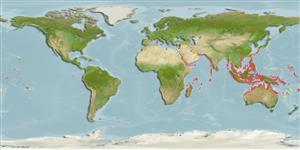
Indo-West Pacific: Red Sea and East Africa to New Caledonia and Vanuatu, north to southern Japan. Reported from Fiji and Tuvalu (Ref. 12596).The exact range is uncertain because of confusion of this species with Sphyraena jello and Sphyraena qenie (Ref. 9768).
Tamaño / Peso / Edad
Madurez: Lm ? range ? - ? cm
Max length : 90.0 cm TL macho / no sexado; (Ref. 2334); common length : 60.0 cm TL macho / no sexado; (Ref. 9768)
Espinas dorsales (total) : 6; Radios blandos dorsales (total) : 9; Espinas anales: 2; Radios blandos anales: 7 - 9. Many typical chevron dark markings crossing lateral line on body; caudal fin largely blackish. No gill rakers on first arch, upper and lower gill arch with rough platelets, each platelet not bearing distinct spine.
Body shape (shape guide): elongated.
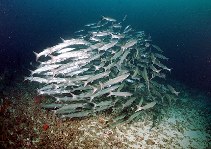
Found near prominent current-swept lagoons or seaward reefs (Ref. 9710). Also in bays and inner turbid lagoons (Ref. 9768). Nocturnally active, but occurring in relatively large schools during the day (Ref. 9768). Sold fresh or processed into fish cakes (Ref. 27550).
Ciclo vital y comportamiento de apareamiento
Madurez | Reproducción | Puesta | Huevos | Fecundidad | Larva
Randall, J.E., G.R. Allen and R.C. Steene, 1990. Fishes of the Great Barrier Reef and Coral Sea. University of Hawaii Press, Honolulu, Hawaii. 506 p. (Ref. 2334)
Situación en la Lista Roja de la UICN (Ref. 130435: Version 2025-2 (Global))
Amenaza para el ser humano
Harmless
Usos humanos
Pesquerías: comercial; pesca deportiva: si
Herramientas
Informes especiales
Descargar XML
Fuentes de Internet
Estimaciones basadas en modelos
Temperatura preferida (Referencia
123201): 24.5 - 29.3, mean 28.4 °C (based on 3674 cells).
Índice de diversidad filogenética (Referencia
82804): PD
50 = 0.5000 [Uniqueness, from 0.5 = low to 2.0 = high].
Bayesian length-weight: a=0.00741 (0.00455 - 0.01207), b=2.93 (2.79 - 3.07), in cm total length, based on LWR estimates for this species & Genus-body shape (Ref.
93245).
Nivel trófico (Referencia
69278): 4.5 ±0.0 se; based on diet studies.
Generation time: 2.9 ( na - na) years. Estimated as median ln(3)/K based on 1
growth studies.
Resiliencia (Referencia
120179): Medio, población duplicada en un tiempo mínimo de 1.4-4.4 años (K=0.3).
Vulnerabilidad pesquera (Ref.
59153): Moderate vulnerability (36 of 100).
🛈
Nutrientes (Ref.
124155): Calcium = 19.4 [8.7, 53.5] mg/100g; Iron = 0.31 [0.15, 0.69] mg/100g; Protein = 20.5 [18.4, 22.2] %; Omega3 = 0.0794 [, ] g/100g; Selenium = 29.2 [12.5, 81.0] μg/100g; VitaminA = 36.8 [7.9, 194.0] μg/100g; Zinc = 0.436 [0.265, 0.765] mg/100g (wet weight);