Пластиножаберные (акулы и скаты) (sharks and rays) >
Carcharhiniformes (Ground sharks) >
Pentanchidae (Deepwater catsharks)
Etymology: Apristurus: a-, Latin privative, i.e., without; pristis, from pristes (Gr.), sawyer (but here meaning saw); oura (Gr.), tail, referring to absence of saw-toothed crest of enlarged dermal denticles along upper edge of caudal fin as found in the closely related Pristiurus (=Galeus) (See ETYFish); riveri: In honor of biologist-anthropologist Luis Hugo Howell-Rivero (1899-1986), for his contributions to Cuban ichthyology (this shark described from the north coast of Cuba) (See ETYFish).
Eponymy: Dr Luis Hugo Howell-Rivero (1899–1986) was a Cuban biologist and anthropologist at the University of Havana. [...] (Ref. 128868), visit book page.
Окружающая среда: среда / климатическая зона / пределы глубины / диапазон распространения
экология
морской батидемерсальный; пределы глубины 700 - 1500 m (Ref. 55584). Deep-water; 30°N - 9°N
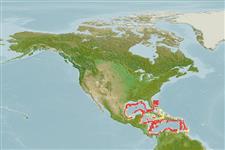
Western Central Atlantic: Cuba, northern Gulf of Mexico, and Panama.
Размер / Вес / Возраст
половая зрелость: Lm ? range ? - ? cm
Max length : 46.0 cm TL самец/пол неопределен; (Ref. 244); 41.0 cm TL (female)
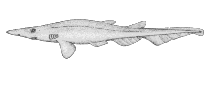
Relatively slender, moderately long, narrow snout and relatively narrow, low caudal fin. Color uniform dark brown (Ref. 37039). First to third gill openings long as the distance between the nostrils (Ref. 6032).
Body shape (shape guide): elongated.
Found on the continental slopes. Oviparous, with one egg per oviduct laid at a time. Sexual dimorphism in adults unusually well-developed.
Жизненный цикл и брачное поведение
половая зрелость | размножение | нерест | икра | Плодовитость | личинки
Oviparous, paired eggs are laid. Embryos feed solely on yolk (Ref. 50449). Sexual dimorphism is evident in dentition of males (Ref. 49562). Males have longer teeth with fewer cusps (Ref. 51093) to make 'courtship biting' more effective (Ref. 49562).
Compagno, L.J.V., 1984. FAO Species Catalogue. Vol. 4. Sharks of the world. An annotated and illustrated catalogue of shark species known to date. Part 2 - Carcharhiniformes. FAO Fish. Synop. 125(4/2):251-655. Rome: FAO. (Ref. 244)
Статус Красного Списка МСОП (Ref. 130435: Version 2025-2 (Global))
Угроза для людей
Harmless
Использование человеком
рыболовство: интереса не представляет
дополнительная информация
инструменты
Специальные отчеты
Скачать в формате XML
ресурсы в Интернет
Оценки, основанные на моделях
Предпочтительная температура (ссылка
123201): 4.9 - 7.9, mean 5.7 °C (based on 95 cells).
Индекс филогенетического разнообразия (ссылка
82804): PD
50 = 0.5000 [Uniqueness, from 0.5 = low to 2.0 = high].
Bayesian length-weight: a=0.00347 (0.00172 - 0.00698), b=3.08 (2.90 - 3.26), in cm total length, based on LWR estimates for this (Sub)family-body shape (Ref.
93245).
Трофический уровень (ссылка
69278): 3.9 ±0.6 se; based on size and trophs of closest relatives
устойчивость к внешним воздействиям (ссылка
120179): очень низкий, минимальное время удвоения популяции более 14 лет (Fec assumed to be <10).
Уязвимость рыбной ловли (Ref.
59153): Moderate vulnerability (36 of 100).
🛈
Питательные вещества (Ref.
124155): Calcium = 10.1 [1.8, 65.5] mg/100g; Iron = 0.358 [0.076, 1.226] mg/100g; Protein = 16.8 [13.6, 19.9] %; Omega3 = 0.225 [0.092, 0.549] g/100g; Selenium = 12.9 [4.1, 41.1] μg/100g; VitaminA = 19.1 [4.1, 92.2] μg/100g; Zinc = 0.379 [0.184, 0.754] mg/100g (wet weight);