Elasmobranchi (squali e razze) (sharks and rays) >
Carcharhiniformes (Ground sharks) >
Pentanchidae (Deepwater catsharks)
Etymology: Apristurus: a-, Latin privative, i.e., without; pristis, from pristes (Gr.), sawyer (but here meaning saw); oura (Gr.), tail, referring to absence of saw-toothed crest of enlarged dermal denticles along upper edge of caudal fin as found in the closely related Pristiurus (=Galeus) (See ETYFish); riveri: In honor of biologist-anthropologist Luis Hugo Howell-Rivero (1899-1986), for his contributions to Cuban ichthyology (this shark described from the north coast of Cuba) (See ETYFish).
Eponymy: Dr Luis Hugo Howell-Rivero (1899–1986) was a Cuban biologist and anthropologist at the University of Havana. [...] (Ref. 128868), visit book page.
Ambiente: milieu / zona climatica / distribuzione batimetrica / gamma di distribuzione
Ecologia
marino batidemersale; distribuzione batimetrica 700 - 1500 m (Ref. 55584). Deep-water; 30°N - 9°N
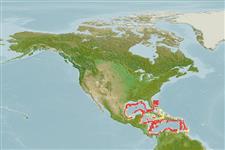
Western Central Atlantic: Cuba, northern Gulf of Mexico, and Panama.
Dimensione / Peso / Età
Maturità: Lm ? range ? - ? cm
Max length : 46.0 cm TL maschio/sesso non determinato; (Ref. 244); 41.0 cm TL (female)
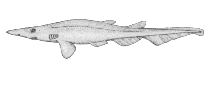
Relatively slender, moderately long, narrow snout and relatively narrow, low caudal fin. Color uniform dark brown (Ref. 37039). First to third gill openings long as the distance between the nostrils (Ref. 6032).
Body shape (shape guide): elongated.
Found on the continental slopes. Oviparous, with one egg per oviduct laid at a time. Sexual dimorphism in adults unusually well-developed.
Ciclo vitale e comportamento di accoppiamento
Maturità | Riproduzione | Deposizione | Uova | Fecondità | Larve
Oviparous, paired eggs are laid. Embryos feed solely on yolk (Ref. 50449). Sexual dimorphism is evident in dentition of males (Ref. 49562). Males have longer teeth with fewer cusps (Ref. 51093) to make 'courtship biting' more effective (Ref. 49562).
Compagno, L.J.V., 1984. FAO Species Catalogue. Vol. 4. Sharks of the world. An annotated and illustrated catalogue of shark species known to date. Part 2 - Carcharhiniformes. FAO Fish. Synop. 125(4/2):251-655. Rome: FAO. (Ref. 244)
Stato della Lista Rossa IUCN (Ref. 130435: Version 2025-2 (Global))
Minaccia per l'uomo
Harmless
Usi umani
Pesca: di nessun interesse
Strumenti
Rapporti speciali
Scarica XML
Fonti Internet
Stime basate su modelli
Temperatura preferita (Fonte Biblio.
123201): 4.9 - 7.9, mean 5.7 °C (based on 95 cells).
Indice di diversità filogenetica (Fonte Biblio.
82804): PD
50 = 0.5000 [Uniqueness, from 0.5 = low to 2.0 = high].
Bayesian length-weight: a=0.00347 (0.00172 - 0.00698), b=3.08 (2.90 - 3.26), in cm total length, based on LWR estimates for this (Sub)family-body shape (Ref.
93245).
Livello trofico (Fonte Biblio.
69278): 3.9 ±0.6 se; based on size and trophs of closest relatives
Resilienza (Fonte Biblio.
120179): Molto basso, tempo minimo di raddoppiamento della popolazione più di 14 anni (Fec assumed to be <10).
Vulnerabilità della pesca (Ref.
59153): Moderate vulnerability (36 of 100).
🛈
Nutrienti (Ref.
124155): Calcium = 10.1 [1.8, 65.5] mg/100g; Iron = 0.358 [0.076, 1.226] mg/100g; Protein = 16.8 [13.6, 19.9] %; Omega3 = 0.225 [0.092, 0.549] g/100g; Selenium = 12.9 [4.1, 41.1] μg/100g; VitaminA = 19.1 [4.1, 92.2] μg/100g; Zinc = 0.379 [0.184, 0.754] mg/100g (wet weight);