Ambiente: milieu / zona climática / intervalo de profundidade / gama de distribuição
Ecologia
marinhas bentopelágico; intervalo de profundidade 2 - 1190 m (Ref. 40919). Tropical
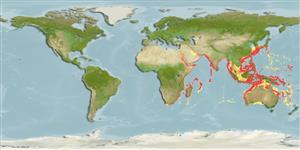
Indo-West Pacific: Red Sea and False Bay, South Africa to Vanuatu, north to southern Japan, south to Australia.
Tamanho / Peso / Idade
Maturidade: Lm ? range ? - ? cm
Max length : 53.0 cm SL macho/indeterminado; (Ref. 4404)
Descrição breve
Chaves de identificação | Morfologia | Morfometria
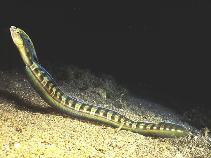
Espinhos dorsais (total) : 13 - 14; Raios dorsais moles (total) : 105 - 119; Espinhos anais: 2; Raios anais moles: 107 - 119. Easily distinguished from other blennies by an extremely elongate body. Dorsal fin origin above eye.
Body shape (shape guide): eel-like; Cross section: circular.
Adults occur on open soft-bottom and mud habitats from shallow bays to deep water. They are found in tube-like burrows in sand or mud bottoms (Ref. 9710). Very rarely encountered but more usually seen at night (Ref. 90102). Nocturnal feeders. Stomach of two specimens trawled in 50-54 m off western India contain crustaceans (including copepods), polychaete remains, forams, fish scales, and some sand and mud (Ref. 11441). Oviparous. Eggs are demersal and adhesive (Ref. 205), and are attached to the substrate via a filamentous, adhesive pad or pedestal (Ref. 94114). Larvae are planktonic, often found in shallow, coastal waters (Ref. 94114). Have eel-like bodies but are rarely seen swimming away from their burrow (Ref. 48636).
Ciclo de vida e comportamento de acasalamento
Maturidade | Reprodução | Desova | Ovos | Fecundidade | Larvas
Oviparous, distinct pairing (Ref. 205).
Randall, J.E., G.R. Allen and R.C. Steene, 1990. Fishes of the Great Barrier Reef and Coral Sea. University of Hawaii Press, Honolulu, Hawaii. 506 p. (Ref. 2334)
Categoria na Lista Vermelha da IUCN (Ref. 130435: Version 2025-2 (Global))
Ameaça para o homem
Harmless
Utilização humana
Pescarias: espécies comerciais; Aquário: Espécies comerciais
Ferramentas
Relatórios especiais
Descarregue XML
Fontes da internet
Estimativas baseadas em modelos
Temperatura preferida (Ref.
123201): 8 - 19.8, mean 12.4 °C (based on 836 cells).
Índice de diversidade filogenética (Ref.
82804): PD
50 = 0.7500 [Uniqueness, from 0.5 = low to 2.0 = high].
Bayesian length-weight: a=0.00102 (0.00046 - 0.00225), b=3.06 (2.88 - 3.24), in cm total length, based on all LWR estimates for this body shape (Ref.
93245).
Nível Trófico (Ref.
69278): 3.9 ±0.5 se; based on size and trophs of closest relatives
Resiliência (Ref.
120179): Médio, tempo mínimo de duplicação da população 1,4 - 4,4 anos (Assuming tm=1-3 and Fec=100-1000).
Vulnerabilidade da pesca (Ref.
59153): Moderate to high vulnerability (46 of 100).
🛈