Xiphasia setifer, Hairtail blenny : fisheries, aquarium

You can sponsor this page

Xiphasia setifer Swainson, 1839

Hairtail blenny
Beobachtung melden im Fish Watcher
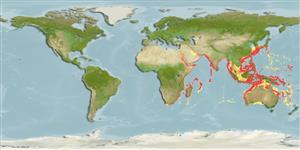
Native range
This map was computer-generated and has not yet been reviewed.
Xiphasia setifer   AquaMaps   Data sources: GBIF OBIS
Hochladen Photos und videos
Bilder | videos | Google Bild
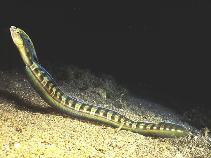
Image of Xiphasia setifer (Hairtail blenny)
Xiphasia setifer
Photo von Yin, Robert

Klassifizierung / Names Namen | Synonyme | Catalog of Fishes(Gattung, Arten) | ITIS | CoL | WoRMS | Cloffa

> Blenniiformes (Blennies) > Blenniidae (Combtooth blennies) > Blenniinae
Etymology: Xiphasia: Greek, xiphos = sword (Ref. 45335).
More on author: Swainson.

Umwelt: Milieu / Klimazone / Tiefenbereich / Verbreitungsgebiet Ökologie

seewasser benthopelagisch; tiefenbereich 2 - 1190 m (Ref. 40919). Tropical

Verbreitung Territorien | FAO Gebiete | Ökosysteme | Vorkommen | Punkt Karte | Einführungen | Faunafri

Indo-West Pacific: Red Sea and False Bay, South Africa to Vanuatu, north to southern Japan, south to Australia.

Größe / Gewicht / Alter

Geschlechtsreife: Lm ?  range ? - ? cm
Max length : 53.0 cm SL Männchen/unbestimmt; (Ref. 4404)

Kurzbeschreibung Bestimmungsschlüssel | Morphologie | Morphometrie

Rückenflossenstacheln (insgesamt) : 13 - 14; Rückenflossenweichstrahlen (insgesamt) : 105 - 119; Afterflossenstacheln: 2; Afterflossenweichstrahlen: 107 - 119. Easily distinguished from other blennies by an extremely elongate body. Dorsal fin origin above eye.
Body shape (shape guide): eel-like; Cross section: circular.

Biologie     Fachlexikon (Englisch) (z.B. epibenthic)

Adults occur on open soft-bottom and mud habitats from shallow bays to deep water. They are found in tube-like burrows in sand or mud bottoms (Ref. 9710). Very rarely encountered but more usually seen at night (Ref. 90102). Nocturnal feeders. Stomach of two specimens trawled in 50-54 m off western India contain crustaceans (including copepods), polychaete remains, forams, fish scales, and some sand and mud (Ref. 11441). Oviparous. Eggs are demersal and adhesive (Ref. 205), and are attached to the substrate via a filamentous, adhesive pad or pedestal (Ref. 94114). Larvae are planktonic, often found in shallow, coastal waters (Ref. 94114). Have eel-like bodies but are rarely seen swimming away from their burrow (Ref. 48636).

Lebenszyklus und Paarungsverhalten Geschlechtsreife | Fortpflanzung | Ablaichen | Eier | Fruchtbarkeit | Larven

Oviparous, distinct pairing (Ref. 205).

Hauptreferenz Laden Sie Ihre Referenzen hoch | Referenzen | Koordinator : Williams, Jeffrey T. | Partner

Randall, J.E., G.R. Allen and R.C. Steene, 1990. Fishes of the Great Barrier Reef and Coral Sea. University of Hawaii Press, Honolulu, Hawaii. 506 p. (Ref. 2334)

IUCN Rote Liste Status (Ref. 130435: Version 2025-2 (Global))

  nicht bedroht (LC) ; Date assessed: 28 March 2009

CITES

Not Evaluated

CMS (Ref. 116361)

Not Evaluated

Bedrohung für Menschen

  Harmless


Nutzung durch Menschen

Fischereien: kommerziell; Aquarium: Kommerziell
FAO - Publication: search | FishSource |

Mehr Information

Trophische Ökologie
Lebensmittel (Beutetiere)
Nahrungszusammensetzung
Nahrungsaufnahme
Lebensmittelrationen
Räuber
Ökologie
Ökologie
Populationsdynamik
Wachstumsparameter
Max. Alter/Größen
Länge-Gewicht-Rel.
Länge-Länge-Verhältnis.
Längenhäufigkeiten
Massenkonvertierung
Rekrutierung
Dichte
Lebenszyklus
Fortpflanzung
Geschlechtsreife
Reifung/Kiemen rel.
Fruchtbarkeit
Ablaichen
Laichaggregationen
Eier
Eientwicklung
Larven
Larven Pop.Dyn.
Verbreitung
Territorien
FAO Gebiete
Ökosysteme
Vorkommen
Einführungen
BRUVS - Videos
Anatomie
Kiemenoberfläche
Gehirn
Otolith
Physiologie
Körperliche Zusammensetzung
Nährstoffe
Sauerstoffverbrauch
Schwimmart
Schwimmgeschwindigkeit
Visuelle Pigmente
Fischgeräusche
Krankheiten und Parasiten
Toxizität (LC50s)
Genetik
Genom
Genetik
Heterozygotie
Vererbbarkeit
Genetische Vielfalt
Menschenbezogen
Aquakultur-Systeme
Aquakultur Profile
Zuchtlinien
Ciguatera-Fälle
Briefmarken, Münzen, Verschiedenes.
Aufsuchen
Partner
Referenzen
Referenzen

Tools

Zusatzinformationen

Download XML

Internet Quellen

AFORO (otoliths) | Aquatic Commons | BHL | Cloffa | Websites from users | FishWatcher Einträge suchen | CISTI | Catalog of Fishes: Gattung, Arten | DiscoverLife | ECOTOX | FAO - Publication: search | Faunafri | Fishipedia | Fishtrace | GloBI | Google Books | Google Scholar | Google | IGFA World Record | Nationale Datenbanken | OneZoom | Open Tree of Life | Otolith Atlas of Taiwan Fishes | PubMed | Reef Life Survey | Socotra Atlas | TreeBase | Tree of Life | Wikipedia: Gehe zu, Suchen | World Records Freshwater Fishing | Zoobank | Zoologischer Rekord

Schätzungen auf der Grundlage von Modellen

Bevorzugte Temperatur (Ref. 123201): 8 - 19.8, mean 12.4 °C (based on 836 cells).
Phylogenetischer Diversitätsindex (Ref. 82804):  PD50 = 0.7500   [Uniqueness, from 0.5 = low to 2.0 = high].
Bayesian length-weight: a=0.00102 (0.00046 - 0.00225), b=3.06 (2.88 - 3.24), in cm total length, based on all LWR estimates for this body shape (Ref. 93245).
Trophische Ebene (Ref. 69278):  3.9   ±0.5 se; based on size and trophs of closest relatives
Widerstandsfähigkeit (Ref. 120179):  mittel, Verdopplung der Population dauert 1,4 - 4,4 Jahre. (Assuming tm=1-3 and Fec=100-1000).
Anfälligkeit der Fischerei (Ref. 59153):  Moderate to high vulnerability (46 of 100). 🛈
Preiskategorie (Ref. 80766):   Unknown.