Umwelt: Milieu / Klimazone / Tiefenbereich / Verbreitungsgebiet
Ökologie
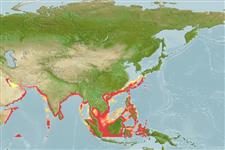
seewasser; brackwasser demersal; tiefenbereich 9 - 125 m (Ref. 9895). Tropical; 31°N - 13°S, 47°E - 143°E
Indo-West Pacific: Persian Gulf to Sri Lanka and Indonesia, north to southern Japan. Reported occurrence of this species from Niue (Ref. 3804) should be verified.
Länge bei der ersten Reifung / Größe / Gewicht / Alter
Geschlechtsreife: Lm 20.1 range ? - ? cm
Max length : 40.0 cm TL Männchen/unbestimmt; (Ref. 11441); common length : 30.0 cm TL Männchen/unbestimmt; (Ref. 3391)
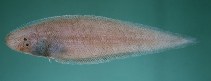
Rückenflossenstacheln (insgesamt) : 0; Rückenflossenweichstrahlen (insgesamt) : 116 - 130; Afterflossenstacheln: 0; Afterflossenweichstrahlen: 85 - 98; Wirbelzahl: 50 - 57. Eyed side uniform brown, with a dark patch on gill cover, blind side white. Body elongate, its depth 20 to 26% SL. Eyes with a small scaly interorbital space. Snout obtusely pointed. Rostral hook short. Corner of mouth reaching posteriorly to or beyond lower of eye, about midway between gill opening and tip of snout. Caudal-fin rays usually 10. Midlateral-line scales 56 to 70. Scales large, ctenoid on eyed side of body. Cycloid (smooth) on blind side. Scale rows between lateral lines on eyed side of body 7 to 9 (Ref 9895).
Body shape (shape guide): elongated.
Inhabits muddy and sandy bottoms of the continental shelf down to 125 m. Enters estuaries and tidal rivers (Ref. 1479). Feeds predominantly on bottom-living invertebrates. Marketed mostly fresh and frozen; also dried-salted (Ref. 9895).
Masuda, H., K. Amaoka, C. Araga, T. Uyeno and T. Yoshino, 1984. The fishes of the Japanese Archipelago. Vol. 1. Tokai University Press, Tokyo, Japan. 437 p. (text). (Ref. 559)
IUCN Rote Liste Status (Ref. 130435: Version 2025-2 (Global))
Bedrohung für Menschen
Harmless
Nutzung durch Menschen
Fischereien: kommerziell
Tools
Zusatzinformationen
Download XML
Internet Quellen
Schätzungen auf der Grundlage von Modellen
Bevorzugte Temperatur (Ref.
123201): 23.5 - 28.7, mean 27.7 °C (based on 550 cells).
Phylogenetischer Diversitätsindex (Ref.
82804): PD
50 = 0.5000 [Uniqueness, from 0.5 = low to 2.0 = high].
Bayesian length-weight: a=0.00324 (0.00282 - 0.00372), b=3.12 (3.08 - 3.16), in cm total length, based on LWR estimates for this species (Ref.
93245).
Trophische Ebene (Ref.
69278): 3.5 ±0.1 se; based on diet studies.
Widerstandsfähigkeit (Ref.
120179): mittel, Verdopplung der Population dauert 1,4 - 4,4 Jahre. (K=0.24-0.98; tm=2;).
Anfälligkeit der Fischerei (Ref.
59153): Moderate vulnerability (37 of 100).
🛈
Nährstoffe (Ref.
124155): Calcium = 149 [70, 257] mg/100g; Iron = 0.909 [0.427, 1.502] mg/100g; Protein = 18.1 [15.9, 20.2] %; Omega3 = 0.12 [0.05, 0.26] g/100g; Selenium = 63.3 [32.5, 122.6] μg/100g; VitaminA = 20.5 [7.8, 50.7] μg/100g; Zinc = 1.33 [0.94, 1.82] mg/100g (wet weight); based on
nutrient studies.