Environnement : milieu / zone climatique / profondeur / gamme de distribution
Écologie
marin; eau douce; saumâtre récifal; amphidrome (Ref. 46888); profondeur 0 - 1 m (Ref. 86942). Tropical
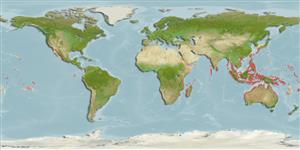
Indo-West Pacific: along East African coast, from Zululand in South Africa northwards to the Red Sea and most of West Indian Ocean islands (Ref. 4756); further east to the Marianas and Samoa; north to Ryukyu Islands, south to western Australia and Oceania (Ref. 2334).
Longueur à la première maturité / Taille / Poids / Âge
Maturité: Lm 5.0 range ? - ? cm
Max length : 19.0 cm TL mâle / non sexé; (Ref. 4756)
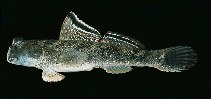
Épines dorsales (Total) : 12 - 18; Rayons mous dorsaux (Total) : 9 - 12; Épines anales: 1; Rayons mous anaux: 8 - 11. Diagnosis: Distinguished by the following characteristics: pelvic fins lacking frenum; little or no membrane uniting medial most pelvic rays; first dorsal fin height moderate, its margin usually convex, occasionally straight, with a black stripe inframarginally and numerous small, white spots posteriorly on fin, no elongate spines; second dorsal fin with single, dusky stripe mesially; dorsal fins not connected by membrane; first dorsal fin with 11-16 spines; longitudinal scale count 64-100; head width 14.3-22.6% of standard length; pelvic fin length 11.3-15.2% of standard length; length of anal fin base 14.0-19.4% of standard length; length of second dorsal-fin base 17.6-23.7% of standard length; total D2 elements 10-13; total anal fin elements 9-12; TRDB 18-26 (Ref. 5218).
Body shape (shape guide): fusiform / normal.
Facultative air-breathing (Ref. 126274); A resident intertidal species with homing behavior (Ref. 32612, 48637) and amphibious air-breather (Ref. 31184, 79840), found in brackish mud flats in mangrove and nipa palm areas. Found in both littoral and estuarine; able to climb out of water, in mangrove swamps and burrowing into intertidal mud banks (Ref. 4756). Occasionally in the lower parts of freshwater streams (Ref. 2847, 44894, 48637, 79840). Actively shuttling back and forth between rock pools and air (Ref. 31184). It feeds on worms, crustaceans, and insects (Ref. 37816). Can stay out of the water for up to 37 h if kept moist (Ref. 51276).
Cycle de vie et comportement reproducteur
Maturité | Reproduction | Frai | Œufs | Fécondité | Larves
Murdy, E.O., 1989. A taxonomic revision and cladistic analysis of the oxudercine gobies (Gobiidae: Oxudercinae). Rec. Aust. Mus., Suppl. 11:1-93. (Ref. 5218)
Statut dans la liste rouge de l'IUCN (Ref. 130435: Version 2025-2 (Global))
Menace pour l'homme
Harmless
Utilisations par l'homme
Pêcheries: sans intérêt; Aquarium: Commercial
Outils
Articles particuliers
Télécharger en XML
Sources Internet
Estimations basées sur des modèles
Température préférée (Réf.
123201): 24.2 - 29.3, mean 28.4 °C (based on 2897 cells).
Indice de diversité phylogénétique (Réf.
82804): PD
50 = 0.5000 [Uniqueness, from 0.5 = low to 2.0 = high].
Bayesian length-weight: a=0.01096 (0.00516 - 0.02330), b=2.97 (2.79 - 3.15), in cm total length, based on LWR estimates for this Genus-body shape (Ref.
93245).
Niveau trophique (Réf.
69278): 3.3 ±0.40 se; based on food items.
Résilience (Réf.
120179): Haut, temps minimum de doublement de population inférieur à 15 mois (Preliminary K or Fecundity.).
Vulnérabilité de la pêche (Ref.
59153): Low vulnerability (10 of 100).
🛈
Nutriments (Ref.
124155): Calcium = 90.6 [43.9, 190.3] mg/100g; Iron = 0.678 [0.320, 1.287] mg/100g; Protein = 19 [17, 21] %; Omega3 = 0.104 [0.045, 0.218] g/100g; Selenium = 11.5 [5.6, 24.8] μg/100g; VitaminA = 115 [29, 427] μg/100g; Zinc = 2 [1, 3] mg/100g (wet weight);