การจำแนกประเภท / ชื่อ
ชื่อสามัญ | ชื่อพ้อง | Catalog of Fishes(สกุล, ชนิด) | ITIS | CoL | WoRMS | Cloffa
สิ่งแวดล้อม : สิ่งแวดล้อม / เขตภูมิอากาศ / ระดับความลึก / ระยะการกระจายสินค้า
นิเวศวิทยา
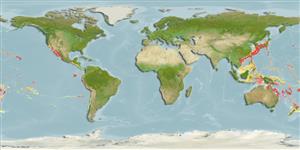
เกี่ยวกับทะเล,น้ำเค็ม สัตว์น้ำหน้าดิน; ระดับความลึก 85 - 510 m (Ref. 58302). Tropical
Western Pacific: confirmed to occur from Japan, Korea and the East China Sea south
to Taiwan.
ขนาด / น้ำหนัก / อายุ
วัยเจริญพันธุ์: Lm ? range ? - ? cm
Max length : 22.3 cm SL เพศผู้/กระเทย; (Ref. 7434); common length : 15.0 cm TL เพศผู้/กระเทย; (Ref. 9137)
คำอธิบายสั้นๆ
เครื่องมือที่ใช้ในการแยกชนิดสัตว์,สิ่งมีชีวิตออกจากกัน | สัณฐานวิทยา | ความยาวต่างๆ
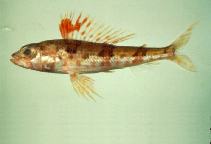
ก้านครีบอ่อนที่หาง (รวม) : 15 - 16; ก้านครีบอ่อนที่ก้น: 9 - 10; สัตว์มีกระดูกสันหลัง: 41 - 43. This species is distinguished by the following characters: D 16, rarely 15; A 10, rarely 9; pectoral fin rays 11, rarely 12; vertebrae41-43; total gill rakers 20 or 21, rarely 19 or 22; lateral line scales 42-43, rarely 41; pyloric caeca 11; in males, dorsal fin is large anteriorly, the membranes deeply incised but none of the rays are filamentous, third or fourth rays longest, reaching 25.7% SL, decreasing in length to middle of fin with posterior rays progressively longer, reaching 19.5% SL, its posterior lobe reaching to or past adipose �n origin; in females, anterior end o fin lower, with membranes deeply incised and rays decreasing in length to middle of fin, lengths of subsequent rays subequal, posterior lobe reaching little more than half way to adipose fin; anal fin in males is relatively deep with posterior lobe approaching hypural crease in large individuals, smaller in females with posterior lobe reaching little more than half way to hypural crease; Males have prominent, large orange to red blotch or markings anteriorly and yellow spots posteriorly in dorsal fin, 3 broad bands on side with wide dark brown margins dorsally, wide yellow stripes on each lobe of caudal fin and white pelvic and anal fins the pelvic somewhat orange basally and anal with broad yellow stripe on basal half; females have orange to red spots scattered on dorsal fin, similar but less defined pattern on side, caudal fine with mottled yellow to orange pattern, similar pelvic fin but no yellow on anal fin (Ref. 94775j).
Body shape (shape guide): elongated; Cross section: compressed.
Found in sandy or muddle areas (Ref. 9137). Benthic (Ref. 58302). Can also be found at 30 m depths (Ref. 11230). A carnivore which feeds on fish and crabs (Ref. 9137).
วงจรชีวิตและพฤติกรรมการผสมพันธุ์
วัยเจริญพันธุ์ | การสืบพันธุ์ | การวางไข่ | เซลสืบพันธ์ของเพศเมีย(ไข่) | ความดกของไข่ | ตัวอ่อน
Randall, J.E. and K.K.P. Lim (eds.), 2000. A checklist of the fishes of the South China Sea. Raffles Bull. Zool. Suppl. (8):569-667. (Ref. 36648)
สถานะบัญชีแดงของ IUCN (Ref. 130435: Version 2025-2 (Global))
ภัยคุกคามต่อมนุษย์
Harmless
การใช้ของมนุษย์
การประมง: การค้า
เครื่องมือ
รายงานพิเศษ
ดาวน์โหลด XML
แหล่งที่มาจากอินเตอร์เน็ต
การประมาณค่าตามแบบจำลอง
อุณหภูมิที่ต้องการ (อ้างอิง
123201): 5.7 - 21.3, mean 15.2 °C (based on 146 cells).
ดัชนีความหลากหลายทางวิวัฒนาการ (อ้างอิง
82804): PD
50 = 0.5020 [Uniqueness, from 0.5 = low to 2.0 = high].
Bayesian length-weight: a=0.00447 (0.00185 - 0.01077), b=3.13 (2.92 - 3.34), in cm total length, based on LWR estimates for this (Sub)family-body shape (Ref.
93245).
ระดับชั้นอาหาร (อ้างอิง
69278): 4.0 ±0.66 se; based on food items.
ความสามารถในการกลับคืนสู่ปกติ (อ้างอิง
120179): ขนาดกลาง, เวลาต่ำสุดที่จะทำให้ประชากรเพิ่มขึ้นเป็น 2 เท่าใช้เวลา 1.4 - 4.4 ปี (Assuming tm=1-3).
ความเสี่ยงต่อการตกปลา (Ref.
59153): Low vulnerability (17 of 100).
🛈