Lingkungan: lingkungan / zona iklim / kisaran kedalaman / jangkauan distribusi
Ekologi
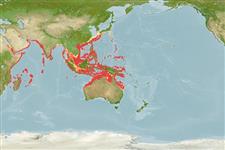
laut dasar (demersal); kisaran kedalaman 18 - 383 m (Ref. 5222). Tropical; 36°N - 24°S, 36°E - 155°E (Ref. 5222)
Indo-West Pacific: spotty distribution from the Red Sea to Japan and Papua New Guinea. Referred to as Epinephelus morrhua morrhua in Japan (Ref. 5978).
Ukuran / Berat / umur
Kematangan: Lm ? range ? - ? cm
Max length : 70.0 cm SL jantan/; (Ref. 4787)
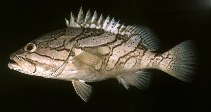
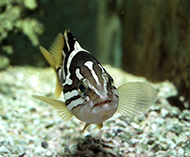
Duri punggung (Keseluruhan (total)) : 11; duri punggung lunak (Keseluruhan (total)) : 13 - 15; Duri dubur: 3; Sirip dubur lunak: 8. Distinguished by the following characteristics: tan body color with 5 oblique dark-edged pale bands; dark bands with scattered small black spots and pale blotches, especially dorsally; pale interspaces with small dark brown spots, mainly arranged in series along the middle of the interspaces; adults with dark brown line from the lower edge of the eye to the edge of the subopercle; faint dark band along the maxillary groove and continuing to the edge of the interopercle; dorsal fin and caudal fin covered with small dark spots; juveniles dark brown with black-edged pale brown bands enclosing numerous small black spots; body depth contained 2.6-3.0 times in SL; head length 2.1-2.3 times in SL; nearly flat interorbital, dorsal head profile slightly convex; 2-5 distinctly enlarged serrae on preopercle angle; upper edge of operculum almost straight; adults posterior nostril diameter 2-3 times that of anterior nostrils; maxilla reaches to or past vertical at rear edge of eye; 2 rows of teeth on midlateral part of lower jaw (Ref. 89707).
Body shape (shape guide): fusiform / normal; Cross section: compressed.
Adults are found at depths between 80 to 383 m; juveniles in 18 to 20 m (Ref. 5222), over hard substrates (Ref. 89707). The species is apparently rare (Ref. 5222).
Siklus hidup dan perilaku kawin
Kematangan | Reproduksi, perkembang biakan | Pemijahan | telur-telur | Fekunditas | Larva
Heemstra, P.C. and J.E. Randall, 1993. FAO Species Catalogue. Vol. 16. Groupers of the world (family Serranidae, subfamily Epinephelinae). An annotated and illustrated catalogue of the grouper, rockcod, hind, coral grouper and lyretail species known to date. Rome: FAO. FAO Fish. Synop. 125(16):382 p. (Ref. 5222)
Status IUCN Red List (Ref. 130435: Version 2025-2 (Global))
ancaman kepada manusia
Harmless
penggunaan manusia
Perikanan: nilai komersial kecil
Alat, peralatan
laporan khas
muat turun XML
Sumber internet
Estimasi berdasarkan model
Suhu yang disukai (Acuan
123201): 16.9 - 27.8, mean 23.7 °C (based on 783 cells).
Indeks keanekaragaman filogenetik (Acuan
82804): PD
50 = 0.5000 [Uniqueness, from 0.5 = low to 2.0 = high].
Bayesian length-weight: a=0.01738 (0.00993 - 0.03041), b=3.11 (2.97 - 3.25), in cm total length, based on LWR estimates for this species & Genus-body shape (Ref.
93245).
Tingkat Trofik (Acuan
69278): 3.8 ±0.61 se; based on food items.
Daya lenting (Acuan
120179): Rendah, Waktu penggandaan populasi minimum 4.5 - 14 tahun (Fec = 55,838).
Kerentanan Penangkapan Ikan (Ref.
59153): Moderate to high vulnerability (54 of 100).
🛈