Taxonomic Remarks
This species is placed in the genus Epinephelus Bloch, 1793 in Eschmeyer (CofF ver. May 2011: Ref. 86870).
Ambiente: milieu / zona climatica / distribuzione batimetrica / gamma di distribuzione
Ecologia
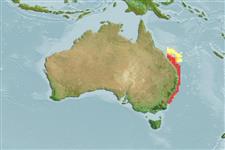
marino demersale; distribuzione batimetrica 15 - 370 m (Ref. 5222). Subtropical; 18°S - 36°S, 150°E - 155°E (Ref. 5222)
Southwest Pacific: off the eastern coast of Australia.
Dimensione / Peso / Età
Maturità: Lm ? range ? - ? cm
Max length : 157 cm TL maschio/sesso non determinato; (Ref. 5222); peso massimo pubblicato: 66.0 kg (Ref. 5222)
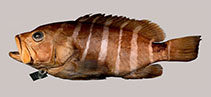
Spine dorsali (totale) : 11; Raggi dorsali molli (totale) : 14 - 15; Spine anali: 3; Raggi anali molli: 9 - 10. Distinguished by the following characteristics: juveniles, pale brown with 7 broad dark bars, last covering most of caudal peduncle, upper half is black; prominent black maxillary streak; dark brown median and pelvic fins; translucent pectoral fins; adults pinkish gray in color, with or without dark bars; fins darker than body with white margins; depth of body contained 2.6-2.9 times in SL; head length 2.4-2.6 times in SL; slightly convex interorbital area and dorsal head profile; subangular preopercle, finely serrate, serrae on rounded corner not enlarged and ventral edge with 1-4 small serrae; almost straight upper edge of operculum; posterior nostrils 2-4 times larger than anterior nostrils; maxilla reaching almost to vertical at rear edge of eye; 2 rows of small teeth on midlateral part of lower jaw (Ref. 89707).
Body shape (shape guide): fusiform / normal; Cross section: compressed.
Found on the continental shelf and continental slope (Ref. 75154). Inhabits rocky reefs (Ref. 89707). Juveniles are found at depths between 15 and 128 m. Occurrence at lesser depths in the south off New South Wales is probably related to the cooler sea temperature.
Ciclo vitale e comportamento di accoppiamento
Maturità | Riproduzione | Deposizione | Uova | Fecondità | Larve
Craig, M.T. and P.A. Hastings, 2007. A molecular phylogeny of the groupers of the subfamily Epinephelinae (Serranidae) with revised classification of the epinephelini. Ichthyol. Res. 54:1-17. (Ref. 83414)
Stato della Lista Rossa IUCN (Ref. 130435: Version 2025-2 (Global))
Minaccia per l'uomo
Harmless
Usi umani
Pesca: pesca di sussistenza
Strumenti
Rapporti speciali
Scarica XML
Fonti Internet
Stime basate su modelli
Temperatura preferita (Fonte Biblio.
123201): 18.8 - 23.5, mean 20.3 °C (based on 11 cells).
Indice di diversità filogenetica (Fonte Biblio.
82804): PD
50 = 0.5000 [Uniqueness, from 0.5 = low to 2.0 = high].
Bayesian length-weight: a=0.01318 (0.00598 - 0.02904), b=3.04 (2.87 - 3.21), in cm total length, based on LWR estimates for this Genus-body shape (Ref.
93245).
Livello trofico (Fonte Biblio.
69278): 4.0 ±0.7 se; based on size and trophs of closest relatives
Resilienza (Fonte Biblio.
120179): Molto basso, tempo minimo di raddoppiamento della popolazione più di 14 anni (Preliminary K or Fecundity.).
Vulnerabilità della pesca (Ref.
59153): Very high vulnerability (90 of 100).
🛈