Taxonomic Remarks
This species is placed in the genus Epinephelus Bloch, 1793 in Eschmeyer (CofF ver. May 2011: Ref. 86870).
Environnement : milieu / zone climatique / profondeur / gamme de distribution
Écologie
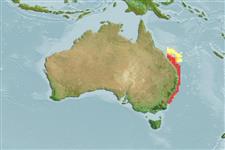
marin démersal; profondeur 15 - 370 m (Ref. 5222). Subtropical; 18°S - 36°S, 150°E - 155°E (Ref. 5222)
Southwest Pacific: off the eastern coast of Australia.
Taille / Poids / Âge
Maturité: Lm ? range ? - ? cm
Max length : 157 cm TL mâle / non sexé; (Ref. 5222); poids max. publié: 66.0 kg (Ref. 5222)
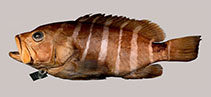
Épines dorsales (Total) : 11; Rayons mous dorsaux (Total) : 14 - 15; Épines anales: 3; Rayons mous anaux: 9 - 10. Distinguished by the following characteristics: juveniles, pale brown with 7 broad dark bars, last covering most of caudal peduncle, upper half is black; prominent black maxillary streak; dark brown median and pelvic fins; translucent pectoral fins; adults pinkish gray in color, with or without dark bars; fins darker than body with white margins; depth of body contained 2.6-2.9 times in SL; head length 2.4-2.6 times in SL; slightly convex interorbital area and dorsal head profile; subangular preopercle, finely serrate, serrae on rounded corner not enlarged and ventral edge with 1-4 small serrae; almost straight upper edge of operculum; posterior nostrils 2-4 times larger than anterior nostrils; maxilla reaching almost to vertical at rear edge of eye; 2 rows of small teeth on midlateral part of lower jaw (Ref. 89707).
Body shape (shape guide): fusiform / normal; Cross section: compressed.
Found on the continental shelf and continental slope (Ref. 75154). Inhabits rocky reefs (Ref. 89707). Juveniles are found at depths between 15 and 128 m. Occurrence at lesser depths in the south off New South Wales is probably related to the cooler sea temperature.
Cycle de vie et comportement reproducteur
Maturité | Reproduction | Frai | Œufs | Fécondité | Larves
Craig, M.T. and P.A. Hastings, 2007. A molecular phylogeny of the groupers of the subfamily Epinephelinae (Serranidae) with revised classification of the epinephelini. Ichthyol. Res. 54:1-17. (Ref. 83414)
Statut dans la liste rouge de l'IUCN (Ref. 130435: Version 2025-2 (Global))
Menace pour l'homme
Harmless
Utilisations par l'homme
Pêcheries: pêcheries vivrières
Outils
Articles particuliers
Télécharger en XML
Sources Internet
Estimations basées sur des modèles
Température préférée (Réf.
123201): 18.8 - 23.5, mean 20.3 °C (based on 11 cells).
Indice de diversité phylogénétique (Réf.
82804): PD
50 = 0.5000 [Uniqueness, from 0.5 = low to 2.0 = high].
Bayesian length-weight: a=0.01318 (0.00598 - 0.02904), b=3.04 (2.87 - 3.21), in cm total length, based on LWR estimates for this Genus-body shape (Ref.
93245).
Niveau trophique (Réf.
69278): 4.0 ±0.7 se; based on size and trophs of closest relatives
Résilience (Réf.
120179): Très faible, temps minimum de doublement de population supérieur à 14 ans (Preliminary K or Fecundity.).
Vulnérabilité de la pêche (Ref.
59153): Very high vulnerability (90 of 100).
🛈