>
Ophidiiformes (Cusk eels) >
Bythitidae (Livebearing brotulas)
Etymology: Brosmophyciops: Greek, brosomai, bibrosko = to eat up, to devour + Greek, phykis = a fish that lives among alga (Greek, phyke) + Greek, ops =appearance (Ref. 45335).
Eponymy: Clarence F Pautzke (1907–1971) was the chief biologist, Game Department, State of Washington. [...] (Ref. 128868), visit book page.
More on author: Schultz.
Umwelt: Milieu / Klimazone / Tiefenbereich / Verbreitungsgebiet
Ökologie
seewasser riff-verbunden; tiefenbereich 6 - 54 m (Ref. 1602). Tropical; 30°N - 27°S
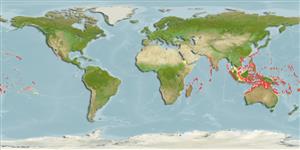
Indo-Pacific: Red Sea to Samoa and the Austral Islands, north to the Ryukyu Islands, south to Rowley Shoals. Recorded from the Gulf of Aqaba and the Gulf of Thailand (Ref. 34024).
Größe / Gewicht / Alter
Geschlechtsreife: Lm ? range ? - ? cm
Max length : 7.5 cm TL Männchen/unbestimmt; (Ref. 90102)
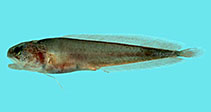
Rückenflossenstacheln (insgesamt) : 0; Rückenflossenweichstrahlen (insgesamt) : 78 - 84; Afterflossenstacheln: 0; Afterflossenweichstrahlen: 58 - 62. When alive, body coloration is brown with translucent orange fins and is covered in a thick granular mucus (Ref. 1602).
Body shape (shape guide): elongated; Cross section: compressed.
Lives in the interstices of lagoon or seaward reefs (Ref. 1602). Benthic (Ref. 75154). Body covered with heavy coating of mucus (Ref. 1602).
Lebenszyklus und Paarungsverhalten
Geschlechtsreife | Fortpflanzung | Ablaichen | Eier | Fruchtbarkeit | Larven
Nielsen, J.G., D.M. Cohen, D.F. Markle and C.R. Robins, 1999. Ophidiiform fishes of the world (Order Ophidiiformes). An annotated and illustrated catalogue of pearlfishes, cusk-eels, brotulas and other ophidiiform fishes known to date. FAO Fish. Synop. 125(18):178p. Rome: FAO. (Ref. 34024)
IUCN Rote Liste Status (Ref. 130435: Version 2025-2 (Global))
Bedrohung für Menschen
Harmless
Nutzung durch Menschen
Fischereien: nicht kommerziell
Tools
Zusatzinformationen
Download XML
Internet Quellen
Schätzungen auf der Grundlage von Modellen
Bevorzugte Temperatur (Ref.
123201): 25.3 - 28.9, mean 27.7 °C (based on 556 cells).
Phylogenetischer Diversitätsindex (Ref.
82804): PD
50 = 1.0000 [Uniqueness, from 0.5 = low to 2.0 = high].
Bayesian length-weight: a=0.00479 (0.00192 - 0.01191), b=3.03 (2.81 - 3.25), in cm total length, based on LWR estimates for this (Sub)family-body shape (Ref.
93245).
Trophische Ebene (Ref.
69278): 3.3 ±0.5 se; based on size and trophs of closest relatives
Widerstandsfähigkeit (Ref.
120179): niedrig, Verdopplung der Population dauert 4,5 - 14 Jahre. (Assuming Fec < 100).
Anfälligkeit der Fischerei (Ref.
59153): Low vulnerability (10 of 100).
🛈
Nährstoffe (Ref.
124155): Calcium = 174 [93, 333] mg/100g; Iron = 1.02 [0.58, 1.78] mg/100g; Protein = 16.7 [14.2, 19.2] %; Omega3 = 0.126 [0.068, 0.228] g/100g; Selenium = 32.8 [15.8, 77.0] μg/100g; VitaminA = 109 [31, 375] μg/100g; Zinc = 2.51 [1.66, 3.61] mg/100g (wet weight);