分類 / 名稱
俗名 | 同種異名 | Catalog of Fishes(屬, 種) | ITIS | CoL | WoRMS | Cloffa
Teleostei >
Ophidiiformes (Cusk eels)
鼬鳚目 (Cusk eels) >
Bythitidae (Livebearing brotulas)
深蛇鳚科 (Livebearing brotulas)
Etymology: Brosmophyciops: Greek, brosomai, bibrosko = to eat up, to devour + Greek, phykis = a fish that lives among alga (Greek, phyke) + Greek, ops =appearance (Ref. 45335).
Eponymy: Clarence F Pautzke (1907–1971) was the chief biologist, Game Department, State of Washington. [...] (Ref. 128868), visit book page.
More on author: Schultz.
環境: 環境 / 氣候帶 / 深度上下限 / 配送範圍
生態學
海洋 礁區魚類; 深度上下限 6 - 54 m (Ref. 1602). 熱帶; 30°N - 27°S
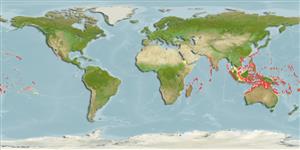
Indo-Pacific: Red Sea to Samoa and the Austral Islands, north to the Ryukyu Islands, south to Rowley Shoals. Recorded from the Gulf of Aqaba and the Gulf of Thailand (Ref. 34024).
印度-太平洋: 紅海到美屬薩摩亞與奧斯垂群島, 北至琉球群島, 南至羅雷淺灘。 記錄自阿卡巴灣與泰國灣了。 (參考文獻 34024)
大小 / 重量 / 年齡
成熟度: Lm ? range ? - ? cm
Max length : 7.5 cm TL 雄魚/尚未辨別雌雄; (Ref. 90102)
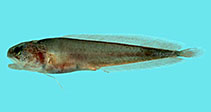
背棘 (總數) : 0; 背的軟條 (總數) : 78 - 84; 臀棘: 0; 臀鰭軟條: 58 - 62. When alive, body coloration is brown with translucent orange fins and is covered in a thick granular mucus (Ref. 1602).
Body shape (shape guide): elongated; Cross section: compressed.
當活著的時候, 身體顏色是褐色的有半透明的橘色鰭而且在一個濃粒狀的黏液被涵蓋.(參考文獻 1602)
Lives in the interstices of lagoon or seaward reefs (Ref. 1602). Benthic (Ref. 75154). Body covered with heavy coating of mucus (Ref. 1602).
生活在潟湖的空隙或臨海礁石。 (參考文獻 1602) 身體覆蓋著黏液的厚厚的一層。 (參考文獻 1602)
生命週期和交配行為
成熟度 | 繁殖 | 產卵場 | 卵 | 孕卵數 | 仔魚
印度-太平洋: 紅海到美屬薩摩亞與奧斯垂群島, 北至琉球群島, 南至羅雷淺灘。 記錄自阿卡巴灣與泰國灣了。 (參考文獻 34024)
Nielsen, J.G., D.M. Cohen, D.F. Markle and C.R. Robins, 1999. Ophidiiform fishes of the world (Order Ophidiiformes). An annotated and illustrated catalogue of pearlfishes, cusk-eels, brotulas and other ophidiiform fishes known to date. FAO Fish. Synop. 125(18):178p. Rome: FAO. (Ref. 34024)
IUCN 瀕危狀態 (Ref. 130435: Version 2025-2 (Global))
無危 (LC) ; Date assessed: 16 August 2019
人類使用
漁業: 沒有興趣
工具
特別的報告
下載 XML
網路資源
基於模型的估計
首選溫度 (參考文獻
123201): 25.3 - 28.9, mean 27.7 °C (based on 556 cells).
系統發育多樣性指數 (參考文獻
82804): PD
50 = 1.0000 [Uniqueness, from 0.5 = low to 2.0 = high].
Bayesian length-weight: a=0.00479 (0.00192 - 0.01191), b=3.03 (2.81 - 3.25), in cm total length, based on LWR estimates for this (Sub)family-body shape (Ref.
93245).
營養階層 (參考文獻
69278): 3.3 ±0.5 se; based on size and trophs of closest relatives
回復力 (參考文獻
120179): 低的, 最小族群倍增時間4.5 - 14 年 (Assuming Fec < 100).
釣魚的脆弱性 (Ref.
59153): Low vulnerability (10 of 100).
🛈
營養素 (Ref.
124155): Calcium = 174 [93, 333] mg/100g; Iron = 1.02 [0.58, 1.78] mg/100g; Protein = 16.7 [14.2, 19.2] %; Omega3 = 0.126 [0.068, 0.228] g/100g; Selenium = 32.8 [15.8, 77.0] μg/100g; VitaminA = 109 [31, 375] μg/100g; Zinc = 2.51 [1.66, 3.61] mg/100g (wet weight);