Ambiente: milieu / zona climática / intervalo de profundidade / gama de distribuição
Ecologia
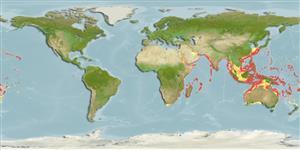
marinhas associadas(os) a recifes; intervalo de profundidade 1 - 650 m (Ref. 34024), usually 180 - 220 m (Ref. 37816). Tropical; 33°N - 38°S, 17°E - 155°W (Ref. 34024)
Indo-Pacific: Red Sea and East Africa to Pitcairn, north to southern Japan, south to Lord Howe Island. Also reported from Persian Gulf (Ref. 68964).
Tamanho / Peso / Idade
Maturidade: Lm ? range ? - ? cm
Max length : 100.0 cm TL macho/indeterminado; (Ref. 5213); common length : 30.0 cm TL macho/indeterminado; (Ref. 9987)
Descrição breve
Chaves de identificação | Morfologia | Morfometria
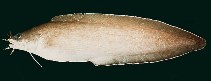
Espinhos dorsais (total) : 0; Raios dorsais moles (total) : 109 - 139; Espinhos anais: 0; Raios anais moles: 80 - 106. In addition to meristic counts, B. multibarbata differs from B. townsendi by possessing a larger eye (width>interorbital space) and having slightly different coloration (dark brown with a submarginal black band and narrow white border on the dorsal and anal fins versus greenish to orange brown with orange-bordered dorsal and anal fins).
Body shape (shape guide): elongated; Cross section: compressed.
Benthopelagic on shelf and upper slope (Ref. 34024). Larvae found in the epipelagic far offshore (Ref. 34024). Found in shallow lagoon and seaward reefs and occurs at depths of at least 220 m. Adults (30-90 cm) move to depths of 100-650 m (Ref. 58472). A nocturnal species, rarely seen for it lives in caves and crevices during the day and periodically emerges from cover at night to feed on crustaceans, mainly crabs, and fishes. Oviparous, with oval pelagic eggs floating in a gelatinous mass (Ref. 205). Utilized fresh and eaten steamed, pan-fried and baked (Ref. 9987). Also Ref. 58302.
Ciclo de vida e comportamento de acasalamento
Maturidade | Reprodução | Desova | Ovos | Fecundidade | Larvas
Nielsen, J.G., D.M. Cohen, D.F. Markle and C.R. Robins, 1999. Ophidiiform fishes of the world (Order Ophidiiformes). An annotated and illustrated catalogue of pearlfishes, cusk-eels, brotulas and other ophidiiform fishes known to date. FAO Fish. Synop. 125(18):178p. Rome: FAO. (Ref. 34024)
Categoria na Lista Vermelha da IUCN (Ref. 130435: Version 2025-2 (Global))
Ameaça para o homem
Harmless
Utilização humana
Pescarias: pouco comercial; peixe desportivo: sim
Ferramentas
Relatórios especiais
Descarregue XML
Fontes da internet
Estimativas baseadas em modelos
Temperatura preferida (Ref.
123201): 13.4 - 23, mean 15.9 °C (based on 98 cells).
Índice de diversidade filogenética (Ref.
82804): PD
50 = 0.5078 [Uniqueness, from 0.5 = low to 2.0 = high].
Bayesian length-weight: a=0.00372 (0.00162 - 0.00852), b=3.14 (2.94 - 3.34), in cm total length, based on LWR estimates for this (Sub)family-body shape (Ref.
93245).
Nível Trófico (Ref.
69278): 3.7 ±0.5 se; based on diet studies.
Resiliência (Ref.
120179): Baixo, tempo mínimo de duplicação da população 4,5 - 14 anos (Preliminary K or Fecundity.).
Vulnerabilidade da pesca (Ref.
59153): High vulnerability (60 of 100).
🛈
Nutrientes (Ref.
124155): Calcium = 25 [13, 44] mg/100g; Iron = 0.433 [0.251, 0.892] mg/100g; Protein = 17.1 [14.5, 19.6] %; Omega3 = 0.116 [0.064, 0.221] g/100g; Selenium = 79.6 [41.6, 152.0] μg/100g; VitaminA = 48.3 [16.9, 136.7] μg/100g; Zinc = 0.852 [0.592, 1.209] mg/100g (wet weight);