>
Gobiiformes (Gobies) >
Gobiidae (Gobies) > Gobiinae
Etymology: Eviota: No etymology given, suggested by Christopher Scharpt: from Latin 'eu' for 'true' and 'iota' for anything very small, in combination 'truly very small' referring to it as being the smallest vertebrate at the time it has benn described by Jenkins (thus, making the suggestion by Scharpt plausible.
More on authors: Lachner & Karnella.
Môi trường: môi trường / vùng khí hậu / Mức độ sâu / phạm vi phân phối
Sinh thái học
biển cùng sống ở rạn san hô; mức độ sâu ? - 44 m (Ref. 86942). Tropical; 25°N - 24°S
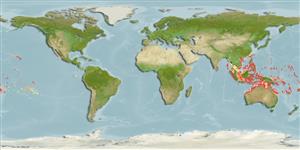
Western Pacific: Australia. Records from other areas may represent different species, from Cocos-Keeling Islands throughout the East Indies; in the south from Bali eastwards to Samoa and New Caledonia and southward to Australia (Scott Reef and the southern Great Barrier Reef); in the north extending to the Yaeyama Islands of Japan and eastward to Micronesia (Palau, FSM - Truk and Enewetak, and the Marshall Islands). Records from Fiji refers to Eviota karaspila.
Bộ gần gũi / Khối lượng (Trọng lượng) / Tuổi
Chín muồi sinh dục: Lm ? range ? - ? cm
Max length : 3.0 cm SL con đực/không giới tính; (Ref. 48637)
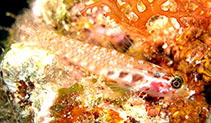
Các tia vây lưng cứng (tổng cộng) : 5 - 7; Các vây lưng mềm (tổng cộng) : 8 - 10; Tia cứng vây hậu môn: 1; Tia mềm vây hậu môn: 8 - 9. Characterized by semi-transparent body with red-brown internal bars; irregular reddish blotches on nape; presence of intense black spot above gill opening; three red blotches separated by white or yellow bars on side of belly; base of pectoral fin with narrow white band; longitudinal scale series 23-25; ctenoid scales, absent on head and breast; separated pelvic fins, thin membrane joining bases; depth of body 6.5-7.7 in SL (Ref. 90102). Dorsal to anal fin-ray formula 9/8 (Ref. 116739).
Body shape (shape guide): elongated; Cross section: compressed.
Found on rocks of corals reefs in the infralittoral zone (Ref. 559, 48637). Solitary or in groups, resting at bottom (Ref 90102). Spawning appears to be repeated on a regular cycle, semilunar or every 14 days (Ref. 116739).
Vòng đời và hành vi giao phối
Chín muồi sinh dục | Sự tái sinh sản | Đẻ trứng | Các trứng | Sự sinh sản | Ấu trùng
Myers, R.F., 1991. Micronesian reef fishes. Second Ed. Coral Graphics, Barrigada, Guam. 298 p. (Ref. 1602)
Tình trạng Sách đỏ IUCN (Ref. 130435: Version 2025-2 (Global))
Mối đe dọa đối với con người
Harmless
Sử dụng của con người
Các công cụ
Báo cáo đặc biệt
Tải xuống XML
Các nguồn internet
Ước tính dựa trên mô hình
Nhiệt độ ưa thích (Tài liệu tham khảo
123201): 25.4 - 28.9, mean 27.9 °C (based on 524 cells).
Chỉ số đa dạng phát sinh loài (Tài liệu tham khảo
82804): PD
50 = 0.5000 [Uniqueness, from 0.5 = low to 2.0 = high].
Bayesian length-weight: a=0.00692 (0.00281 - 0.01706), b=3.09 (2.92 - 3.26), in cm total length, based on LWR estimates for this Genus-body shape (Ref.
93245).
Mức dinh dưỡng (Tài liệu tham khảo
69278): 3.1 ±0.3 se; based on size and trophs of closest relatives
Generation time: 0.1 ( na - na) years. Estimated as median ln(3)/K based on 1
growth studies.
Thích nghi nhanh (Tài liệu tham khảo
120179): Chiêù cao, thời gian nhân đôi của chủng quần tối thiểu là dưới 15 tháng (Preliminary K or Fecundity.).
Sự dễ bị tổn thương của nghề đánh cá (Ref.
59153): Low vulnerability (10 of 100).
🛈
Chất dinh dưỡng (Ref.
124155): Calcium = 1330 [158, 29,821] mg/100g; Iron = 9.6 [1.1, 60.1] mg/100g; Protein = 17.4 [13.4, 21.2] %; Omega3 = 0.0782 [, ] g/100g; Selenium = 476 [12, 13,279] μg/100g; VitaminA = 3.15 [0.03, 248.84] μg/100g; Zinc = 21.9 [3.7, 83.0] mg/100g (wet weight);