>
Gobiiformes (Gobies) >
Gobiidae (Gobies) > Gobiinae
Etymology: Eviota: No etymology given, suggested by Christopher Scharpt: from Latin 'eu' for 'true' and 'iota' for anything very small, in combination 'truly very small' referring to it as being the smallest vertebrate at the time it has benn described by Jenkins (thus, making the suggestion by Scharpt plausible.
More on authors: Lachner & Karnella.
Umwelt: Milieu / Klimazone / Tiefenbereich / Verbreitungsgebiet
Ökologie
seewasser riff-verbunden; tiefenbereich ? - 44 m (Ref. 86942). Tropical; 25°N - 24°S
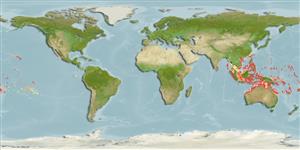
Western Pacific: Australia. Records from other areas may represent different species, from Cocos-Keeling Islands throughout the East Indies; in the south from Bali eastwards to Samoa and New Caledonia and southward to Australia (Scott Reef and the southern Great Barrier Reef); in the north extending to the Yaeyama Islands of Japan and eastward to Micronesia (Palau, FSM - Truk and Enewetak, and the Marshall Islands). Records from Fiji refers to Eviota karaspila.
Größe / Gewicht / Alter
Geschlechtsreife: Lm ? range ? - ? cm
Max length : 3.0 cm SL Männchen/unbestimmt; (Ref. 48637)
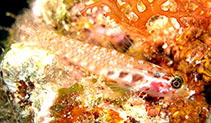
Rückenflossenstacheln (insgesamt) : 5 - 7; Rückenflossenweichstrahlen (insgesamt) : 8 - 10; Afterflossenstacheln: 1; Afterflossenweichstrahlen: 8 - 9. Characterized by semi-transparent body with red-brown internal bars; irregular reddish blotches on nape; presence of intense black spot above gill opening; three red blotches separated by white or yellow bars on side of belly; base of pectoral fin with narrow white band; longitudinal scale series 23-25; ctenoid scales, absent on head and breast; separated pelvic fins, thin membrane joining bases; depth of body 6.5-7.7 in SL (Ref. 90102). Dorsal to anal fin-ray formula 9/8 (Ref. 116739).
Body shape (shape guide): elongated; Cross section: compressed.
Found on rocks of corals reefs in the infralittoral zone (Ref. 559, 48637). Solitary or in groups, resting at bottom (Ref 90102). Spawning appears to be repeated on a regular cycle, semilunar or every 14 days (Ref. 116739).
Lebenszyklus und Paarungsverhalten
Geschlechtsreife | Fortpflanzung | Ablaichen | Eier | Fruchtbarkeit | Larven
Myers, R.F., 1991. Micronesian reef fishes. Second Ed. Coral Graphics, Barrigada, Guam. 298 p. (Ref. 1602)
IUCN Rote Liste Status (Ref. 130435: Version 2025-2 (Global))
Bedrohung für Menschen
Harmless
Nutzung durch Menschen
Tools
Zusatzinformationen
Download XML
Internet Quellen
Schätzungen auf der Grundlage von Modellen
Bevorzugte Temperatur (Ref.
123201): 25.4 - 28.9, mean 27.9 °C (based on 524 cells).
Phylogenetischer Diversitätsindex (Ref.
82804): PD
50 = 0.5000 [Uniqueness, from 0.5 = low to 2.0 = high].
Bayesian length-weight: a=0.00692 (0.00281 - 0.01706), b=3.09 (2.92 - 3.26), in cm total length, based on LWR estimates for this Genus-body shape (Ref.
93245).
Trophische Ebene (Ref.
69278): 3.1 ±0.3 se; based on size and trophs of closest relatives
Generation time: 0.1 ( na - na) years. Estimated as median ln(3)/K based on 1
growth studies.
Widerstandsfähigkeit (Ref.
120179): hoch, Verdopplung der Population dauert weniger als 15 Monate. (Preliminary K or Fecundity.).
Anfälligkeit der Fischerei (Ref.
59153): Low vulnerability (10 of 100).
🛈
Nährstoffe (Ref.
124155): Calcium = 1330 [158, 29,821] mg/100g; Iron = 9.6 [1.1, 60.1] mg/100g; Protein = 17.4 [13.4, 21.2] %; Omega3 = 0.0782 [, ] g/100g; Selenium = 476 [12, 13,279] μg/100g; VitaminA = 3.15 [0.03, 248.84] μg/100g; Zinc = 21.9 [3.7, 83.0] mg/100g (wet weight);