>
Gobiiformes (Gobies) >
Gobiidae (Gobies) > Gobiinae
Etymology: Bathygobius: Greek, bathys = deep + Latin, gobius = gudgeon (Ref. 45335).
More on author: Rüppell.
สิ่งแวดล้อม : สิ่งแวดล้อม / เขตภูมิอากาศ / ระดับความลึก / ระยะการกระจายสินค้า
นิเวศวิทยา
เกี่ยวกับทะเล,น้ำเค็ม; น้ำจืด; กร่อย เกี่ยวกับหินโสโครก; สัตว์น้ำที่อพยพไปๆมาๆ ระหว่างแหล่งน้ำจืดกับทะเล ที่เป็นไปตามช่วงชีวิต (Ref. 51243); ระดับความลึก 0 - 6 m (Ref. 86942). Tropical; 30°N - 30°S
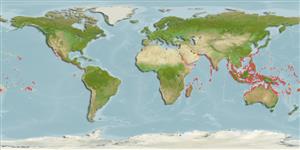
Indo-Pacific: Red Sea south to Bazaruto, Mozambique (Ref. 2798) and east to the Line and Tuamoto islands, north to South Korea and southern Japan, south to the southern Great Barrier Reef. Does not occur in the Hawaiian Islands (Ref. 7490).
ขนาด / น้ำหนัก / อายุ
วัยเจริญพันธุ์: Lm ? range ? - ? cm
Max length : 12.0 cm TL เพศผู้/กระเทย; (Ref. 4343)
คำอธิบายสั้นๆ
เครื่องมือที่ใช้ในการแยกชนิดสัตว์,สิ่งมีชีวิตออกจากกัน | สัณฐานวิทยา | ความยาวต่างๆ
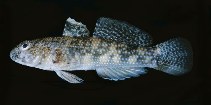
เงี่ยงครีบหลัง (รวม) : 7; ก้านครีบอ่อนที่หาง (รวม) : 9; เงี่ยงครีบก้น: 1; ก้านครีบอ่อนที่ก้น: 8. Characterized further by pale yellowish brown color with large, irregular dark brown blotches on body; small, pale blue spots (one per scale) in longitudinal rows on body; dorsal and caudal fins with small blue spots, outer edge of dorsal fins broadly yellow; upper three pectoral rays partly free of membrane; rounded caudal fin; longitudinal scale series 29-36; predorsal scales 10-19, reaching from above middle of preopercle nearly to interorbital space; cheek and opercle without scales; ctenoid body scales, becoming cycloid on abdomen, breast and nape; depressed head, width greater than depth; depth of body 4.4-5.0 in SL (Ref. 90102).
Body shape (shape guide): fusiform / normal.
Inhabits shallow rocky areas, often in pools of the intertidal zone (Ref. 2798). Occurs mostly in coastal areas. Also found in estuaries, tidal zones and often ascending into freshwater streams; smaller species live between branches of corals where they exploit several crustacean groups. Feeds on crustaceans, fish and algae (Ref. 92840). Sometimes seen as fresh catches at markets (Ref. 12693).
วงจรชีวิตและพฤติกรรมการผสมพันธุ์
วัยเจริญพันธุ์ | การสืบพันธุ์ | การวางไข่ | เซลสืบพันธ์ของเพศเมีย(ไข่) | ความดกของไข่ | ตัวอ่อน
Benthic spawner. Also Ref. 32023.
Hoese, D.F., 1986. Gobiidae. p. 774-807. In M.M. Smith and P.C. Heemstra (eds.) Smiths' sea fishes. Springer-Verlag, Berlin. (Ref. 2798)
สถานะบัญชีแดงของ IUCN (Ref. 130435: Version 2025-2 (Global))
ภัยคุกคามต่อมนุษย์
Harmless
การใช้ของมนุษย์
การประมง: มีการค้าเพียงเล็กน้อย
เครื่องมือ
รายงานพิเศษ
ดาวน์โหลด XML
แหล่งที่มาจากอินเตอร์เน็ต
การประมาณค่าตามแบบจำลอง
อุณหภูมิที่ต้องการ (อ้างอิง
123201): 24.9 - 29.3, mean 28.4 °C (based on 3467 cells).
ดัชนีความหลากหลายทางวิวัฒนาการ (อ้างอิง
82804): PD
50 = 0.5000 [Uniqueness, from 0.5 = low to 2.0 = high].
Bayesian length-weight: a=0.01023 (0.00477 - 0.02194), b=3.01 (2.83 - 3.19), in cm total length, based on LWR estimates for this (Sub)family-body shape (Ref.
93245).
ระดับชั้นอาหาร (อ้างอิง
69278): 3.4 ±0.6 se; based on diet studies.
ความสามารถในการกลับคืนสู่ปกติ (อ้างอิง
120179): ความสูง, เวลาต่ำสุดที่จะทำให้ประชากรเพิ่มขึ้นเป็น 2 เท่าใช้เวลาน้อยกว่า 15 เดือน (Preliminary K or Fecundity.).
ความเสี่ยงต่อการตกปลา (Ref.
59153): Low vulnerability (10 of 100).
🛈
สารอาหาร (Ref.
124155): Calcium = 114 [61, 258] mg/100g; Iron = 0.861 [0.426, 1.636] mg/100g; Protein = 18.7 [16.7, 20.4] %; Omega3 = 0.134 [0.057, 0.266] g/100g; Selenium = 15.1 [7.5, 32.3] μg/100g; VitaminA = 195 [53, 659] μg/100g; Zinc = 2.01 [1.31, 3.06] mg/100g (wet weight);