>
Gobiiformes (Gobies) >
Gobiidae (Gobies) > Gobiinae
Etymology: Bathygobius: Greek, bathys = deep + Latin, gobius = gudgeon (Ref. 45335).
More on author: Rüppell.
Umwelt: Milieu / Klimazone / Tiefenbereich / Verbreitungsgebiet
Ökologie
seewasser; süßwasser; brackwasser riff-verbunden; amphidrom (Ref. 51243); tiefenbereich 0 - 6 m (Ref. 86942). Tropical; 30°N - 30°S
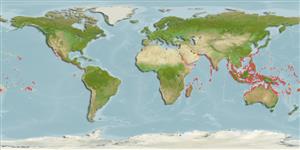
Indo-Pacific: Red Sea south to Bazaruto, Mozambique (Ref. 2798) and east to the Line and Tuamoto islands, north to South Korea and southern Japan, south to the southern Great Barrier Reef. Does not occur in the Hawaiian Islands (Ref. 7490).
Größe / Gewicht / Alter
Geschlechtsreife: Lm ? range ? - ? cm
Max length : 12.0 cm TL Männchen/unbestimmt; (Ref. 4343)
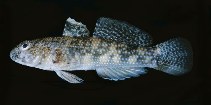
Rückenflossenstacheln (insgesamt) : 7; Rückenflossenweichstrahlen (insgesamt) : 9; Afterflossenstacheln: 1; Afterflossenweichstrahlen: 8. Characterized further by pale yellowish brown color with large, irregular dark brown blotches on body; small, pale blue spots (one per scale) in longitudinal rows on body; dorsal and caudal fins with small blue spots, outer edge of dorsal fins broadly yellow; upper three pectoral rays partly free of membrane; rounded caudal fin; longitudinal scale series 29-36; predorsal scales 10-19, reaching from above middle of preopercle nearly to interorbital space; cheek and opercle without scales; ctenoid body scales, becoming cycloid on abdomen, breast and nape; depressed head, width greater than depth; depth of body 4.4-5.0 in SL (Ref. 90102).
Body shape (shape guide): fusiform / normal.
Inhabits shallow rocky areas, often in pools of the intertidal zone (Ref. 2798). Occurs mostly in coastal areas. Also found in estuaries, tidal zones and often ascending into freshwater streams; smaller species live between branches of corals where they exploit several crustacean groups. Feeds on crustaceans, fish and algae (Ref. 92840). Sometimes seen as fresh catches at markets (Ref. 12693).
Lebenszyklus und Paarungsverhalten
Geschlechtsreife | Fortpflanzung | Ablaichen | Eier | Fruchtbarkeit | Larven
Benthic spawner. Also Ref. 32023.
Hoese, D.F., 1986. Gobiidae. p. 774-807. In M.M. Smith and P.C. Heemstra (eds.) Smiths' sea fishes. Springer-Verlag, Berlin. (Ref. 2798)
IUCN Rote Liste Status (Ref. 130435: Version 2025-2 (Global))
Bedrohung für Menschen
Harmless
Nutzung durch Menschen
Fischereien: weniger kommerziell
Tools
Zusatzinformationen
Download XML
Internet Quellen
Schätzungen auf der Grundlage von Modellen
Bevorzugte Temperatur (Ref.
123201): 24.9 - 29.3, mean 28.4 °C (based on 3467 cells).
Phylogenetischer Diversitätsindex (Ref.
82804): PD
50 = 0.5000 [Uniqueness, from 0.5 = low to 2.0 = high].
Bayesian length-weight: a=0.01023 (0.00477 - 0.02194), b=3.01 (2.83 - 3.19), in cm total length, based on LWR estimates for this (Sub)family-body shape (Ref.
93245).
Trophische Ebene (Ref.
69278): 3.4 ±0.6 se; based on diet studies.
Widerstandsfähigkeit (Ref.
120179): hoch, Verdopplung der Population dauert weniger als 15 Monate. (Preliminary K or Fecundity.).
Anfälligkeit der Fischerei (Ref.
59153): Low vulnerability (10 of 100).
🛈
Nährstoffe (Ref.
124155): Calcium = 114 [61, 258] mg/100g; Iron = 0.861 [0.426, 1.636] mg/100g; Protein = 18.7 [16.7, 20.4] %; Omega3 = 0.134 [0.057, 0.266] g/100g; Selenium = 15.1 [7.5, 32.3] μg/100g; VitaminA = 195 [53, 659] μg/100g; Zinc = 2.01 [1.31, 3.06] mg/100g (wet weight);