Пластиножаберные (акулы и скаты) (sharks and rays) >
Pristiophoriformes (Saw sharks) >
Pristiophoridae (Saw sharks)
Etymology: Pliotrema: pleion (Gr.), more; trema (Gr.), hole, referring to six gill slits compared with five in Pristiophorus (See ETYFish); warreni: In honor of English-born South African zoologist Ernest Warren (1871-1945), Director, Natal Government Museum (Pietermaritzburg), who sent specimens to the British Museum (See ETYFish).
Eponymy: Professor Dr Ernest Warren (1871–1945) was an English zoologist who moved to Natal (1903) and became first Director of the Natal Museum, Pietermaritzburg (1903–1935). [...] (Ref. 128868), visit book page.
More on author: Regan.
Окружающая среда: среда / климатическая зона / пределы глубины / диапазон распространения
экология
морской демерсальный; пределы глубины 10 - 915 m (Ref. 122027), usually 60 - 430 m (Ref. 122027). Subtropical; 22°S - 37°S, 19°E - 45°E (Ref. 54706)
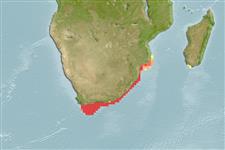
Western Indian Ocean: off Madagascar and from southern Mozambique to Cape Agulhas, South Africa.
Длина при первой зрелости / Размер / Вес / Возраст
половая зрелость: Lm ?, range 110 - ? cm
Max length : 170 cm TL самец/пол неопределен; (Ref. 5578)
Краткое описание
определительные ключи | морфология | морфометрия
This large six-gilled sawshark is distinguished by the following characters: barbel origin to anterior nostrils 1.4-1.6 times anterior nostrils to symphysis upper jaw; prenarial length 1.3-1.4 times prebarbel length; preoral length 1.8-2.3 times interdorsal space; pectoral-fin anterior margin 1.4-1.5 times dorsal-caudal space; mouth width 3.1-3.9 times spiracle length; the first dorsal fin originates about opposite pectoral-fin free rear tips; lateral trunk dermal denticles tricuspidate, rather flat and imbricated. monospondylous centra 53-56; precaudal diplospondylous centra 4-51; total vertebral centra 154-158; rostrum not constricted between barbel origin and nostrils and barbels that are situated about two thirds way from rostral tip to mouth, with prebarbel length about twice, i.e. 1.7-2.1 times, distance from barbel origin to symphysis of upper jaw (vs. barbels situated about half way from rostral tip to mouth, with prebarbel length about equal, i.e. 1.0-1.1 times, distance from barbel origin to symphysis of upper jaw), prebarbel length 60.2-68.0% (vs. 49.4-52.9% of preoral length), preoral length 1.5-1.7 (vs. 1.9-2.0 times prebarbel length), prenarial length 1.3-1.4 (vs. 1.5-1.7 times prebarbel length). Colouration: medium to dark brown dorsally with a pronounced yellowish longitudinal stripe; uniform white ventrally; the dorsal rostrum surface with two distinct longitudinal dark stripes, lateral rostral teeth dark-edged (Ref. 122027).
Cross section: angular.
Found on the continental shelf and upper slope to at least 430 m (Ref. 247). Feeds on bony fish, also shrimp, mysids and squid (Ref. 5578). Ovoviviparous (Ref. 50449), with 5 to 7 young in a litter (Ref. 247). Probably uses its saw to stun and kill prey (Ref. 5578). Sometimes caught by sports anglers (Ref. 5578).
Ovoviviparous, with 5 to 7 young in a litter (others have 7 to 17 developing eggs). Size at birth about 35 cm. Embryos feed solely on yolk (Ref. 50449).
Weigmann, S., O. Gon, R.H. Leeney, E. Barrowclift, P. Berggren, N. Jiddawi and A.J. Temple, 2020. Revision of the sixgill sawsharks, genus Pliotrema (Chondrichthyes, Pristiophoriformes), with descriptions of two new species and a redescription of P. warreni Regan. PLoS ONE, 15 (3)[0228791]:1-56. (Ref. 122027)
Статус Красного Списка МСОП (Ref. 130435: Version 2025-2 (Global))
Угроза для людей
Harmless
Использование человеком
рыболовство: интереса не представляет; объект спортивного рыболовства: да
дополнительная информация
инструменты
Специальные отчеты
Скачать в формате XML
ресурсы в Интернет
Оценки, основанные на моделях
Предпочтительная температура (ссылка
123201): 11.2 - 21.7, mean 15.8 °C (based on 40 cells).
Индекс филогенетического разнообразия (ссылка
82804): PD
50 = 0.6270 [Uniqueness, from 0.5 = low to 2.0 = high].
Bayesian length-weight: a=0.00389 (0.00180 - 0.00842), b=3.12 (2.94 - 3.30), in cm total length, based on all LWR estimates for this body shape (Ref.
93245).
Трофический уровень (ссылка
69278): 4.2 ±0.6 se; based on diet studies.
устойчивость к внешним воздействиям (ссылка
120179): очень низкий, минимальное время удвоения популяции более 14 лет (Fec=5).
Уязвимость рыбной ловли (Ref.
59153): Very high vulnerability (90 of 100).
🛈