Élasmobranches (requins et raies) (sharks and rays) >
Pristiophoriformes (Saw sharks) >
Pristiophoridae (Saw sharks)
Etymology: Pliotrema: pleion (Gr.), more; trema (Gr.), hole, referring to six gill slits compared with five in Pristiophorus (See ETYFish); warreni: In honor of English-born South African zoologist Ernest Warren (1871-1945), Director, Natal Government Museum (Pietermaritzburg), who sent specimens to the British Museum (See ETYFish).
Eponymy: Professor Dr Ernest Warren (1871–1945) was an English zoologist who moved to Natal (1903) and became first Director of the Natal Museum, Pietermaritzburg (1903–1935). [...] (Ref. 128868), visit book page.
More on author: Regan.
Environnement : milieu / zone climatique / profondeur / gamme de distribution
Écologie
marin démersal; profondeur 10 - 915 m (Ref. 122027), usually 60 - 430 m (Ref. 122027). Subtropical; 22°S - 37°S, 19°E - 45°E (Ref. 54706)
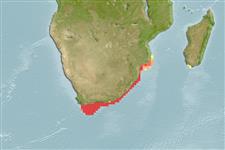
Western Indian Ocean: off Madagascar and from southern Mozambique to Cape Agulhas, South Africa.
Longueur à la première maturité / Taille / Poids / Âge
Maturité: Lm ?, range 110 - ? cm
Max length : 170 cm TL mâle / non sexé; (Ref. 5578)
Description synthétique
Clés d'identification | Morphologie | Morphométrie
This large six-gilled sawshark is distinguished by the following characters: barbel origin to anterior nostrils 1.4-1.6 times anterior nostrils to symphysis upper jaw; prenarial length 1.3-1.4 times prebarbel length; preoral length 1.8-2.3 times interdorsal space; pectoral-fin anterior margin 1.4-1.5 times dorsal-caudal space; mouth width 3.1-3.9 times spiracle length; the first dorsal fin originates about opposite pectoral-fin free rear tips; lateral trunk dermal denticles tricuspidate, rather flat and imbricated. monospondylous centra 53-56; precaudal diplospondylous centra 4-51; total vertebral centra 154-158; rostrum not constricted between barbel origin and nostrils and barbels that are situated about two thirds way from rostral tip to mouth, with prebarbel length about twice, i.e. 1.7-2.1 times, distance from barbel origin to symphysis of upper jaw (vs. barbels situated about half way from rostral tip to mouth, with prebarbel length about equal, i.e. 1.0-1.1 times, distance from barbel origin to symphysis of upper jaw), prebarbel length 60.2-68.0% (vs. 49.4-52.9% of preoral length), preoral length 1.5-1.7 (vs. 1.9-2.0 times prebarbel length), prenarial length 1.3-1.4 (vs. 1.5-1.7 times prebarbel length). Colouration: medium to dark brown dorsally with a pronounced yellowish longitudinal stripe; uniform white ventrally; the dorsal rostrum surface with two distinct longitudinal dark stripes, lateral rostral teeth dark-edged (Ref. 122027).
Cross section: angular.
Found on the continental shelf and upper slope to at least 430 m (Ref. 247). Feeds on bony fish, also shrimp, mysids and squid (Ref. 5578). Ovoviviparous (Ref. 50449), with 5 to 7 young in a litter (Ref. 247). Probably uses its saw to stun and kill prey (Ref. 5578). Sometimes caught by sports anglers (Ref. 5578).
Cycle de vie et comportement reproducteur
Maturité | Reproduction | Frai | Œufs | Fécondité | Larves
Ovoviviparous, with 5 to 7 young in a litter (others have 7 to 17 developing eggs). Size at birth about 35 cm. Embryos feed solely on yolk (Ref. 50449).
Weigmann, S., O. Gon, R.H. Leeney, E. Barrowclift, P. Berggren, N. Jiddawi and A.J. Temple, 2020. Revision of the sixgill sawsharks, genus Pliotrema (Chondrichthyes, Pristiophoriformes), with descriptions of two new species and a redescription of P. warreni Regan. PLoS ONE, 15 (3)[0228791]:1-56. (Ref. 122027)
Statut dans la liste rouge de l'IUCN (Ref. 130435: Version 2025-2 (Global))
Menace pour l'homme
Harmless
Utilisations par l'homme
Pêcheries: sans intérêt; pêche sportive: oui
Outils
Articles particuliers
Télécharger en XML
Sources Internet
Estimations basées sur des modèles
Température préférée (Réf.
123201): 11.2 - 21.7, mean 15.8 °C (based on 40 cells).
Indice de diversité phylogénétique (Réf.
82804): PD
50 = 0.6270 [Uniqueness, from 0.5 = low to 2.0 = high].
Bayesian length-weight: a=0.00389 (0.00180 - 0.00842), b=3.12 (2.94 - 3.30), in cm total length, based on all LWR estimates for this body shape (Ref.
93245).
Niveau trophique (Réf.
69278): 4.2 ±0.6 se; based on diet studies.
Résilience (Réf.
120179): Très faible, temps minimum de doublement de population supérieur à 14 ans (Fec=5).
Vulnérabilité de la pêche (Ref.
59153): Very high vulnerability (90 of 100).
🛈