Classificazione / Nomi
Nomi Comuni | Sinonimi | Catalog of Fishes(Genere, Specie) | ITIS | CoL | WoRMS | Cloffa
>
Siluriformes (Catfishes) >
Callichthyidae (Callichthyid armored catfishes) > Corydoradinae
Etymology: Corydoras: Greek, kory = helmet + greek, doras = skin (Ref. 45335); desana: Named after an ethnic group that inhabits the rio Tiquié basin, the Desana, which is closely related linguistically and culturally to the Tukano indians, who also inhabit the rio Tiquié basin; This name is also referring to the resemblance between the mimic pair C. desana and C. tukano; name in apposition.
Ambiente: milieu / zona climatica / distribuzione batimetrica / gamma di distribuzione
Ecologia
; acqua dolce demersale. Tropical
South America: Brazil.
Dimensione / Peso / Età
Maturità: Lm ? range ? - ? cm
Max length : 5.1 cm SL maschio/sesso non determinato; (Ref. 138491)
Breve descrizione
Chiavi di identificazione | Morfologia | Morfometria
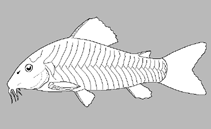
This species is distinguished by the following characters: color pattern with ground color clear, with three large blotches, the first one (‘mask’) in the head at the eye level, the second humeral blotch at the dorsal fin level, and a third blotch at the caudal peduncle; sout long, 59.3-70.6% of head length, or 1.4-1.7 within the head length; pectoral-fin spine with well-developed serrations along posterior margin (Ref. 138491).
Body shape (shape guide): short and / or deep; Cross section: oval.
Currently known only from the Igarapé Castanha, a tributary of the rio Tiquié (itself a tributary of rio Uaupés), upper rio Negro basin, Amazonas state, in Brazil. It was only recorded a little upstream of the indian village of Santa Rosa and other collecting sites downstream the Igarapé Castanha and along the rio Tiquié only revealed its co-mimic, Corydoras tukano, which is not only more distributed but also considerably more abundant than the rare C. desana. The four specimens of Corydoras desana collected between September and November 2006 were schooling along with C. tukano at sandy beaches. The Igarapé Castanha is a meandering river with oxbow lakes, alternating sandy beaches and river terraces, with clear water, but with a considerable amount of suspended sediments (quite distinct from the rio Tiquié, which is a typical black water river at least before its junction with the Igarapé Castanha) (Ref. 138491).
Ciclo vitale e comportamento di accoppiamento
Maturità | Riproduzione | Deposizione | Uova | Fecondità | Larve
Lima, F.C.T. and I. Sazima, 2017. Corydoras desana, a new plated catfish from the upper rio Negro, Brazil, with comments on mimicry within Corydoradinae (Ostariophysi: Siluriformes: Callichthyidae). aqua, International Journal of Ichthyology 23(1):19-31. (Ref. 138491)
Stato della Lista Rossa IUCN (Ref. 130435: Version 2025-2 (Global))
Minaccia per l'uomo
Harmless
Usi umani
Strumenti
Rapporti speciali
Scarica XML
Fonti Internet
Stime basate su modelli
Indice di diversità filogenetica (Fonte Biblio.
82804): PD
50 = 0.5000 [Uniqueness, from 0.5 = low to 2.0 = high].
Bayesian length-weight: a=0.02455 (0.00934 - 0.06448), b=3.00 (2.77 - 3.23), in cm total length, based on LWR estimates for this (Sub)family-body shape (Ref.
93245).
Livello trofico (Fonte Biblio.
69278): 3.0 ±0.3 se; based on size and trophs of closest relatives
Resilienza (Fonte Biblio.
120179): Alto, tempo minimo di raddoppiamento della popolazione meno di 15 mesi (Preliminary K or Fecundity.).
Vulnerabilità della pesca (Ref.
59153): Low vulnerability (10 of 100).
🛈