Classification / Noms
Noms communs | Synonymes | Catalog of Fishes(Genre, Espèce) | ITIS | CoL | WoRMS | Cloffa
>
Siluriformes (Catfishes) >
Callichthyidae (Callichthyid armored catfishes) > Corydoradinae
Etymology: Corydoras: Greek, kory = helmet + greek, doras = skin (Ref. 45335); desana: Named after an ethnic group that inhabits the rio Tiquié basin, the Desana, which is closely related linguistically and culturally to the Tukano indians, who also inhabit the rio Tiquié basin; This name is also referring to the resemblance between the mimic pair C. desana and C. tukano; name in apposition.
Environnement : milieu / zone climatique / profondeur / gamme de distribution
Écologie
; eau douce démersal. Tropical
Distribution
Territoires | Zones FAO | Écosystèmes | Occurrences | Carte par point | Introductions | Faunafri
South America: Brazil.
Taille / Poids / Âge
Maturité: Lm ? range ? - ? cm
Max length : 5.1 cm SL mâle / non sexé; (Ref. 138491)
Description synthétique
Clés d'identification | Morphologie | Morphométrie
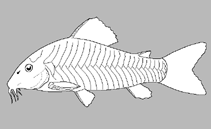
This species is distinguished by the following characters: color pattern with ground color clear, with three large blotches, the first one (‘mask’) in the head at the eye level, the second humeral blotch at the dorsal fin level, and a third blotch at the caudal peduncle; sout long, 59.3-70.6% of head length, or 1.4-1.7 within the head length; pectoral-fin spine with well-developed serrations along posterior margin (Ref. 138491).
Body shape (shape guide): short and / or deep; Cross section: oval.
Currently known only from the Igarapé Castanha, a tributary of the rio Tiquié (itself a tributary of rio Uaupés), upper rio Negro basin, Amazonas state, in Brazil. It was only recorded a little upstream of the indian village of Santa Rosa and other collecting sites downstream the Igarapé Castanha and along the rio Tiquié only revealed its co-mimic, Corydoras tukano, which is not only more distributed but also considerably more abundant than the rare C. desana. The four specimens of Corydoras desana collected between September and November 2006 were schooling along with C. tukano at sandy beaches. The Igarapé Castanha is a meandering river with oxbow lakes, alternating sandy beaches and river terraces, with clear water, but with a considerable amount of suspended sediments (quite distinct from the rio Tiquié, which is a typical black water river at least before its junction with the Igarapé Castanha) (Ref. 138491).
Cycle de vie et comportement reproducteur
Maturité | Reproduction | Frai | Œufs | Fécondité | Larves
Lima, F.C.T. and I. Sazima, 2017. Corydoras desana, a new plated catfish from the upper rio Negro, Brazil, with comments on mimicry within Corydoradinae (Ostariophysi: Siluriformes: Callichthyidae). aqua, International Journal of Ichthyology 23(1):19-31. (Ref. 138491)
Statut dans la liste rouge de l'IUCN (Ref. 130435: Version 2025-2 (Global))
Menace pour l'homme
Harmless
Utilisations par l'homme
Outils
Articles particuliers
Télécharger en XML
Sources Internet
Estimations basées sur des modèles
Indice de diversité phylogénétique (Réf.
82804): PD
50 = 0.5000 [Uniqueness, from 0.5 = low to 2.0 = high].
Bayesian length-weight: a=0.02455 (0.00934 - 0.06448), b=3.00 (2.77 - 3.23), in cm total length, based on LWR estimates for this (Sub)family-body shape (Ref.
93245).
Niveau trophique (Réf.
69278): 3.0 ±0.3 se; based on size and trophs of closest relatives
Résilience (Réf.
120179): Haut, temps minimum de doublement de population inférieur à 15 mois (Preliminary K or Fecundity.).
Vulnérabilité de la pêche (Ref.
59153): Low vulnerability (10 of 100).
🛈