This website uses cookies to enhance your browsing experience and ensure the functionality of our site. For more detailed information about the types of cookies we use and how we protect your privacy, please visit our Privacy Information page.
×
Cookie Settings
This website uses different types of cookies to enhance your experience. Please select your preferences below:
> Siluriformes (Catfishes) > Auchenoglanididae (Flatnose catfishes)
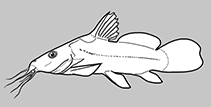
Etymology: Parauchenoglanis:Greek, para = near + Greek, auchen = neck + Greek, glanis = a fish that can eat the bait without touching the hook; a cat fish (Ref. 45335); dolichorhinus:Name from Greek ‘dolichorhinus’, ‘dolichos’ meaning long and ‘rhinus’ meaning snout, referring to the long snout (preorbital length) of this species in comparison to the other species in the P. ngamensis group.
背鰭 (合計) : 7; 臀鰭: 9 - 10; 脊つい: 35 - 36. This species is distinguished from its congeners ahli, altipinnis, balayi, buettikoferi, longiceps, monkei, pantherinus, punctatus by having a broad humeral process (vs. pointed humeral process); further differs from altipinnis, balayi, pantherinus, punctatus by the coarse skin (vs. smooth skin); differs from buettikoferi, monkei by the anterior margin of the pectoral-fin spine mostly smooth (vs. serrated from base to tip); differs from zebratus by the humeral process clearly visible through the skin, presence of five to six bars on small or vertical rows of spots on large, and anterior margin of the pectoral-fin spine mostly smooth (vs. humeral process embedded under the skin, four to five vertical rows of spots on small specimens or four to five bars on larger specimens, and anterior margin of the pectoral-fin spine mostly serrated); differs from stiassnyae by the absence of black background spots in between the vertical bars or rows of spots (vs. reticulated pattern), a depressed head, head depth 34.6%-40.0% HL (vs. moderately depressed head, head depth 43.5%-58.7% HL), and a narrow body depth, 11.6%-14.0% SL (vs. a deeper body depth, 15.7%-22.7% SL); differs from all other species of the P. ngamensis species group by a depressed head; head depth 34.6%-40.0% HL (vs. a moderately depressed head; head depth 40.6%-60.8% HL in ngamensis, 48.5%-54.9% HL in patersoni, 41.2%-50.3% HL in lueleensis, 41.7%-42.0% HL in poikilos, 49.5%-54.0% HL in ernstswartzi, 42.0%-53.5% HL in chiumbeensis, 48.2%-59.2% HL in luendaensis), by the narrow body depth, 11.6%-14.0% SL (vs. deeper body depth, 14.6%-23.5% SL in ngamensis, 15.5%-21.4% SL patersoni, 15.0%-17.4% SL in lueleensis, 16.0%-16.2% SL in poikilos, 18.2%-19.9% SL in ernstswartzi, 20.2%-20.9% SL in megalasma, 14.8%-21.3% SL in luendaensis, 14.5%-18.9% SL in chiumbeensis); further differs from lueleensis, poikilos, ernstswartzi, megalasma by a narrow interpectoral distance, 17.4%-18.2% SL (vs. wider, 18.8%-22.5% SL in lueleensis, 18.4%-21.0% SL in poikilos, 19.8%-20.6% SL in ernstswartzi, 18.8%-21.9 % SL in megalasma) and by having unspotted fins (vs. fins with numerous black spots in ngamensis, lueleensis, poikilos or faint spots in chiumbeensis or blotches in ernstswartzi, megalasma (Ref. 132425). Cross section: oval.
Sithole, Y., E.J.W.M.N. Vreven, P.H.N. Bragança, T. Musschoot and A. Chakona, 2024. Nine in one: integrative taxonomic evidence of hidden species diversity in the widespread Zambezi grunter, Parauchenoglanis ngamensis (Siluriformes: Auchenoglanididae), from southern and south-central Africa. Zool. J. Linn. Soc. 202:1-33. (Ref. 132425)
IUCNのレッドリストの状況は (Ref. 130435: Version 2025-2 (Global))
系統多様性指数 (参照 82804): PD50 = 0.5000 [Uniqueness, from 0.5 = low to 2.0 = high].
Bayesian length-weight: a=0.00525 (0.00219 - 0.01260), b=3.09 (2.87 - 3.31), in cm total length, based on LWR estimates for this (Sub)family-body shape (Ref. 93245).
栄養段階 (参照 69278): 3.5 ±0.6 se; based on size and trophs of closest relatives
回復力 (参照 120179): 高い, 15か月以下の倍増期間の最小個体群 (Preliminary K or Fecundity.).
漁業の脆弱性 (Ref. 59153): Low vulnerability (10 of 100). 🛈