>
Siluriformes (Catfishes) >
Auchenoglanididae (Flatnose catfishes)
Etymology: Parauchenoglanis: Greek, para = near + Greek, auchen = neck + Greek, glanis = a fish that can eat the bait without touching the hook; a cat fish (Ref. 45335); dolichorhinus: Name from Greek ‘dolichorhinus’, ‘dolichos’ meaning long and ‘rhinus’ meaning snout, referring to the long snout (preorbital length) of this species in comparison to the other species in the P. ngamensis group.
Lingkungan: lingkungan / zona iklim / kisaran kedalaman / jangkauan distribusi
Ekologi
; air tawar bentopelagis. Tropical
Africa: Angola.
Ukuran / Berat / umur
Kematangan: Lm ? range ? - ? cm
Max length : 14.0 cm SL jantan/; (Ref. 132425)
deskripsi pendek
Kunci identifiaksi (pengenalan) | Morfologi | Morfometrik
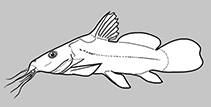
duri punggung lunak (Keseluruhan (total)) : 7; Sirip dubur lunak: 9 - 10; vertebrata, bertulang belakang: 35 - 36. This species is distinguished from its congeners ahli, altipinnis, balayi, buettikoferi, longiceps, monkei, pantherinus, punctatus by having a broad humeral process (vs. pointed humeral process); further differs from altipinnis, balayi, pantherinus, punctatus by the coarse skin (vs. smooth skin); differs from buettikoferi, monkei by the anterior margin of the pectoral-fin spine mostly smooth (vs. serrated from base to tip); differs from zebratus by the humeral process clearly visible through the skin, presence of five to six bars on small or vertical rows of spots on large, and anterior margin of the pectoral-fin spine mostly smooth (vs. humeral process embedded under the skin, four to five vertical rows of spots on small specimens or four to five bars on larger specimens, and anterior margin of the pectoral-fin spine mostly serrated); differs from stiassnyae by the absence of black background spots in between the vertical bars or rows of spots (vs. reticulated pattern), a depressed head, head depth 34.6%-40.0% HL (vs. moderately depressed head, head depth 43.5%-58.7% HL), and a narrow body depth, 11.6%-14.0% SL (vs. a deeper body depth, 15.7%-22.7% SL); differs from all other species of the P. ngamensis species group by a depressed head; head depth 34.6%-40.0% HL (vs. a moderately depressed head; head depth 40.6%-60.8% HL in ngamensis, 48.5%-54.9% HL in patersoni, 41.2%-50.3% HL in lueleensis, 41.7%-42.0% HL in poikilos, 49.5%-54.0% HL in ernstswartzi, 42.0%-53.5% HL in chiumbeensis, 48.2%-59.2% HL in luendaensis), by the narrow body depth, 11.6%-14.0% SL (vs. deeper body depth, 14.6%-23.5% SL in ngamensis, 15.5%-21.4% SL patersoni, 15.0%-17.4% SL in lueleensis, 16.0%-16.2% SL in poikilos, 18.2%-19.9% SL in ernstswartzi, 20.2%-20.9% SL in megalasma, 14.8%-21.3% SL in luendaensis, 14.5%-18.9% SL in chiumbeensis); further differs from lueleensis, poikilos, ernstswartzi, megalasma by a narrow interpectoral distance, 17.4%-18.2% SL (vs. wider, 18.8%-22.5% SL in lueleensis, 18.4%-21.0% SL in poikilos, 19.8%-20.6% SL in ernstswartzi, 18.8%-21.9 % SL in megalasma) and by having unspotted fins (vs. fins with numerous black spots in ngamensis, lueleensis, poikilos or faint spots in chiumbeensis or blotches in ernstswartzi, megalasma (Ref. 132425).
Cross section: oval.
Siklus hidup dan perilaku kawin
Kematangan | Reproduksi, perkembang biakan | Pemijahan | telur-telur | Fekunditas | Larva
Sithole, Y., E.J.W.M.N. Vreven, P.H.N. Bragança, T. Musschoot and A. Chakona, 2024. Nine in one: integrative taxonomic evidence of hidden species diversity in the widespread Zambezi grunter, Parauchenoglanis ngamensis (Siluriformes: Auchenoglanididae), from southern and south-central Africa. Zool. J. Linn. Soc. 202:1-33. (Ref. 132425)
Status IUCN Red List (Ref. 130435: Version 2025-2 (Global))
ancaman kepada manusia
Harmless
penggunaan manusia
Perikanan: nilai komersial kecil
Alat, peralatan
laporan khas
muat turun XML
Sumber internet
Estimasi berdasarkan model
Indeks keanekaragaman filogenetik (Acuan
82804): PD
50 = 0.5000 [Uniqueness, from 0.5 = low to 2.0 = high].
Bayesian length-weight: a=0.00525 (0.00219 - 0.01260), b=3.09 (2.87 - 3.31), in cm total length, based on LWR estimates for this (Sub)family-body shape (Ref.
93245).
Tingkat Trofik (Acuan
69278): 3.5 ±0.6 se; based on size and trophs of closest relatives
Daya lenting (Acuan
120179): Tinggi, Waktu penggandaan populasi minimum kurang dari 15 bulan (Preliminary K or Fecundity.).
Kerentanan Penangkapan Ikan (Ref.
59153): Low vulnerability (10 of 100).
🛈