>
Anguilliformes (Eels and morays) >
Nettastomatidae (Duckbill eels)
Etymology: Saurenchelys: Greek, sauros = lizard + Greek,enchelys, -yos = eel (Ref. 45335); gigas: Name for Latin 'gigas' meaning giant, referring to its large size.
Entorno: milieu / zona climática / rango de profundidad / gama de distribución
Ecología
marino demersal; rango de profundidad 100 - 200 m (Ref. 106141). Deep-water
Western Pacific: Taiwan and Vietnam.
Tamaño / Peso / Edad
Madurez: Lm ? range ? - ? cm
Max length : 87.2 cm TL macho / no sexado; (Ref. 106141); 115.5 cm TL (female)
Descripción breve
Claves de identificación | Morfología | Morfometría
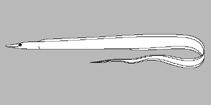
This species is distinguished from other adult congeners by the following characters: predorsal length (40.9-46.8 % of PAL, 65.7-76.1 % of TR), head length (36.8-39.3% of PAL, 56.0-65.7 % of TR), vertebrae (38-40 before anus, and 63-70 precaudal), preanal lateral-line pores 38-42, preanal dorsal-fin rays 56–63, and especially its larger size (the maximum size reaching 115.5 cm TL, 3.3 cm DGO) (Ref. 106141).
Cross section: oval.
Ciclo vital y comportamiento de apareamiento
Madurez | Reproducción | Puesta | Huevos | Fecundidad | Larva
Lin, J., D.G. Smith, K.-T. Shao and H.-M. Chen, 2015. Saurenchelys gigas sp. nov., a new nettastomatid eel (Teleostei, Anguilliformes, Nettastomatidae) from the western central Pacific. Zootaxa 4060(1):121-130. (Ref. 106141)
Situación en la Lista Roja de la UICN (Ref. 130435: Version 2025-2 (Global))
Amenaza para el ser humano
Harmless
Usos humanos
Herramientas
Informes especiales
Descargar XML
Fuentes de Internet
Estimaciones basadas en modelos
Índice de diversidad filogenética (Referencia
82804): PD
50 = 0.5005 [Uniqueness, from 0.5 = low to 2.0 = high].
Bayesian length-weight: a=0.00087 (0.00035 - 0.00219), b=2.98 (2.76 - 3.20), in cm total length, based on LWR estimates for this (Sub)family-body shape (Ref.
93245).
Nivel trófico (Referencia
69278): 3.5 ±0.5 se; based on size and trophs of closest relatives
Resiliencia (Referencia
120179): Medio, población duplicada en un tiempo mínimo de 1.4-4.4 años (Preliminary K or Fecundity.).
Vulnerabilidad pesquera (Ref.
59153): High to very high vulnerability (69 of 100).
🛈