>
Eupercaria/misc (Various families in series Eupercaria) >
Nemipteridae (Threadfin breams, Whiptail breams)
Etymology: Scolopsis: Name from the Greek masculine noun 'skolos' meaning 'thorn' and suffix '-opsis' (from Greek feminine n. 'opsis' meaning 'aspect', 'appearance') meaning ‘thorny appearance’ presumably referring to 'les dentelures de la préopercule, en ont aussi, et même d'épineuses, aux sous-orbitaires' mentioned by Cuvier (1814) in his designation of the genus. Name ending in -'opsis' are treated as feminine according to ICZN 1999: Article 30.1.2 (Ref. 130620).
Meio ambiente: milieu / Zona climática / intervalo de profundidade / faixa de distribuição
Ecologia
marinhas associadas(os) a recifes; intervalo de profundidade 1 - 45 m (Ref. 130620). Tropical
Western Indian Ocean: from the Arabian/Persian Gulf to the Red Sea, south to South Africa (KwaZulu-Natal) and Madagascar, eastwards throughout the Arabian Sea. North Eastern indian Ocean: Bay of Bengal to the Andaman Sea.
Tamanho / Peso / Idade
Maturidade: Lm ? range ? - ? cm
Max length : 16.0 cm SL macho/indeterminado; (Ref. 130620)
Descrição suscinta
Chaves de identificação | Morfologia | Morfometria
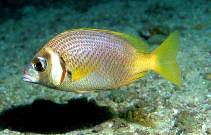
Espinhos dorsais (total) : 10; Raios dorsais (total) : 9; Espinhos anais: 3; Raios anais : 7. This species is distinguished by the following set of characters: head is scaly except for subopercle which is naked with numerous small pores; scales on top of the head reaching forward to between the anterior nostrils and snout tip; lower margin of the eye tangent to a line from snout tip to upper pectoral-fin base; suborbital with a large retrorse spine (a small antrorse spine may also be present on third infraorbital, immediately above suborbital spine); posterior margin of the preopercle is rugose, bearing one or two rows of short blunt spines along its length; second anal-fin spine is longer and more robust than first or third anal-fin spines. Colouration: most body scales, except for breast and caudal peduncle, with greenish yellow spot (spots darker in live fish); caudal peduncle often yellowish; with a broad white bar from nape onto operculum; suborbital with obscure, rectangular, white patch; white band beneath lateral
line never present; the upper limb of opercular margin blackish, while lower limb reddish orange; upper base of pectoral fin with a small wedge-shaped dark spot; fins are yellow (Ref. 130620).
Body shape (shape guide): fusiform / normal; Cross section: oval.
Occurs over mud bottoms near reefs or in open sand areas in turbid waters and usually observed underwater solitary or in pairs (Ref. 130620).
Ciclo de vida ou comportamento de acasalamento
Maturidade | Reprodução | Desova | Ovos | Fecundidade | Larvas
Russell, B.C., S.V. Bogorodsky, A.O. Mal, K.K. Bineesh and T.J. Alpermann, 2022. The taxonomic identity of the monocle bream Scolopsis vosmeri species complex (Perciformes: Nemipteridae), with comments on molecular phylogenetic relationships within the genus Scolopsis. Zootaxa 5105(4):501-538. (Ref. 130620)
Status na Lista Vermelha da UICN (Ref. 130435: Version 2025-2 (Global))
Ameaça para os humanos
Harmless
Uso pelos humanos
Ferramentas
Relatórios especiais
Baixar XML
Fontes da internet
Estimativas baseadas em modelos
Índice de diversidade filogenética (Ref.
82804): PD
50 = 0.5000 [Uniqueness, from 0.5 = low to 2.0 = high].
Bayesian length-weight: a=0.01445 (0.00653 - 0.03199), b=2.98 (2.81 - 3.15), in cm total length, based on LWR estimates for this Genus-body shape (Ref.
93245).
Nível Trófico (Ref.
69278): 3.6 ±0.5 se; based on size and trophs of closest relatives
Resiliência (Ref.
120179): Elevada, tempo mínimo de duplicação da população menor que 15 meses (Preliminary K or Fecundity.).
Vulnerabilidade da pesca (Ref.
59153): Low vulnerability (10 of 100).
🛈