Classificazione / Nomi
Nomi Comuni | Sinonimi | Catalog of Fishes(Genere, Specie) | ITIS | CoL | WoRMS | Cloffa
>
Eupercaria/misc (Various families in series Eupercaria) >
Nemipteridae (Threadfin breams, Whiptail breams)
Etymology: Scolopsis: Name from the Greek masculine noun 'skolos' meaning 'thorn' and suffix '-opsis' (from Greek feminine n. 'opsis' meaning 'aspect', 'appearance') meaning ‘thorny appearance’ presumably referring to 'les dentelures de la préopercule, en ont aussi, et même d'épineuses, aux sous-orbitaires' mentioned by Cuvier (1814) in his designation of the genus. Name ending in -'opsis' are treated as feminine according to ICZN 1999: Article 30.1.2 (Ref. 130620).
Ambiente: milieu / zona climatica / distribuzione batimetrica / gamma di distribuzione
Ecologia
marino associati a barriera corallina; distribuzione batimetrica 1 - 45 m (Ref. 130620). Tropical
Western Indian Ocean: from the Arabian/Persian Gulf to the Red Sea, south to South Africa (KwaZulu-Natal) and Madagascar, eastwards throughout the Arabian Sea. North Eastern indian Ocean: Bay of Bengal to the Andaman Sea.
Dimensione / Peso / Età
Maturità: Lm ? range ? - ? cm
Max length : 16.0 cm SL maschio/sesso non determinato; (Ref. 130620)
Breve descrizione
Chiavi di identificazione | Morfologia | Morfometria
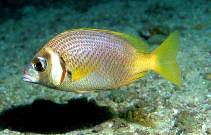
Spine dorsali (totale) : 10; Raggi dorsali molli (totale) : 9; Spine anali: 3; Raggi anali molli: 7. This species is distinguished by the following set of characters: head is scaly except for subopercle which is naked with numerous small pores; scales on top of the head reaching forward to between the anterior nostrils and snout tip; lower margin of the eye tangent to a line from snout tip to upper pectoral-fin base; suborbital with a large retrorse spine (a small antrorse spine may also be present on third infraorbital, immediately above suborbital spine); posterior margin of the preopercle is rugose, bearing one or two rows of short blunt spines along its length; second anal-fin spine is longer and more robust than first or third anal-fin spines. Colouration: most body scales, except for breast and caudal peduncle, with greenish yellow spot (spots darker in live fish); caudal peduncle often yellowish; with a broad white bar from nape onto operculum; suborbital with obscure, rectangular, white patch; white band beneath lateral
line never present; the upper limb of opercular margin blackish, while lower limb reddish orange; upper base of pectoral fin with a small wedge-shaped dark spot; fins are yellow (Ref. 130620).
Body shape (shape guide): fusiform / normal; Cross section: oval.
Occurs over mud bottoms near reefs or in open sand areas in turbid waters and usually observed underwater solitary or in pairs (Ref. 130620).
Ciclo vitale e comportamento di accoppiamento
Maturità | Riproduzione | Deposizione | Uova | Fecondità | Larve
Russell, B.C., S.V. Bogorodsky, A.O. Mal, K.K. Bineesh and T.J. Alpermann, 2022. The taxonomic identity of the monocle bream Scolopsis vosmeri species complex (Perciformes: Nemipteridae), with comments on molecular phylogenetic relationships within the genus Scolopsis. Zootaxa 5105(4):501-538. (Ref. 130620)
Stato della Lista Rossa IUCN (Ref. 130435: Version 2025-2 (Global))
Minaccia per l'uomo
Harmless
Usi umani
Strumenti
Rapporti speciali
Scarica XML
Fonti Internet
Stime basate su modelli
Indice di diversità filogenetica (Fonte Biblio.
82804): PD
50 = 0.5000 [Uniqueness, from 0.5 = low to 2.0 = high].
Bayesian length-weight: a=0.01445 (0.00653 - 0.03199), b=2.98 (2.81 - 3.15), in cm total length, based on LWR estimates for this Genus-body shape (Ref.
93245).
Livello trofico (Fonte Biblio.
69278): 3.6 ±0.5 se; based on size and trophs of closest relatives
Resilienza (Fonte Biblio.
120179): Alto, tempo minimo di raddoppiamento della popolazione meno di 15 mesi (Preliminary K or Fecundity.).
Vulnerabilità della pesca (Ref.
59153): Low vulnerability (10 of 100).
🛈