Elasmobranquios (tiburones y rayas) (sharks and rays) >
Squaliformes (Sleeper and dogfish sharks) >
Dalatiidae (Sleeper sharks)
Etymology: Squaliolus: Diminutive of squalus (L.), a sea-fish, usually applied to sharks, referring to small size of S. laticaudus (See ETYFish); laticaudus: latus (L.), wide or broad; cauda (L.), tail, referring to its broad (but short) caudal fin (See ETYFish).
More on authors: Smith & Radcliffe.
Entorno: milieu / zona climática / rango de profundidad / gama de distribución
Ecología
marino batipelágico; oceanodromo (Ref. 51243); rango de profundidad 200 - 1200 m (Ref. 27000). Deep-water; 48°N - 40°S, 180°W - 180°E
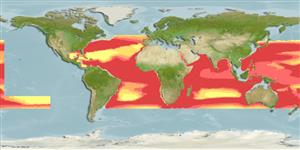
Nearly circumtropical. Western Atlantic: off Bermuda, southern Brazil, and northern Argentina. Eastern Atlantic: off France and Madeira. Western Indian Ocean: off Somalia. Western Pacific: Japan, Taiwan and Philippines (Ref. 13748), as well as Australia (Ref. 7300).
Longitud en la primera madurez / Tamaño / Peso / Edad
Madurez: Lm 18.5, range 17 - 20 cm
Max length : 22.0 cm TL macho / no sexado; (Ref. 247); 25.0 cm TL (female)
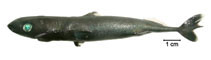
Espinas dorsales (total) : 1; Espinas anales: 0. The spined pygmy shark Squaliolus laticaudus is a very small dogfish (about 25cm) with a large eye (diameter 73-86% of interorbital width), upper margin nearly straight; upper lip without papillae (Ref. 31367, 6871). Color: dark with conspicuously light-margined fins (Ref. 247) . Edge of fins with bright border (Ref. 43998).
S. laticaudus is the type species of the genus which has the following distinctive features: fin spine on its first dorsal fin but not on its second dorsal fin; second dorsal fin long-based and low, about twice the length of first dorsal fin base; first dorsal-fin base closer to pectoral fins than to pelvic fins; and caudal fin nearly symmetrical, paddle-shaped, with subterminal notch present; low lateral keels on caudal peduncle . Body cigar-shaped; snout very long, bulbously conical but slightly pointed; mouth ventral; lips thin; teeth strongly different in both jaws, uppers small, narrow and erect cusps, lowers larger, blade-like and semi erect. Tooth rows 22-23/16-21. (Ref. 247, 6871).
Body shape (shape guide): elongated.
An oceanic, wide-ranging, tropical pelagic species occurring near continental and insular land masses, sometimes over the shelves, but usually over the slopes (Ref. 247). Displays vertical migrations on a diel cycle, seen at the bottom during the day and travels to 200 m at night (Ref. 247). Feeds on deepwater squid, lanternfish, gonostomatids and idiacanthids, and probably follows its prey on their diel migrations (Ref. 247). Ovoviviparous (Ref. 205). Has well-developed photophores densely covering the ventral part of the body and sparsely seen on the sides and hardly developed on the dorsal surface (Ref. 247).
Ciclo vital y comportamiento de apareamiento
Madurez | Reproducción | Puesta | Huevos | Fecundidad | Larva
Probably ovoviviparous. Twelve mature eggs have been found in a single ovary of a mature female but this does not imply that large litters are produced (Ref. 247). Distinct pairing with embrace (Ref. 205).
Compagno, L.J.V., 1984. FAO Species Catalogue. Vol. 4. Sharks of the world. An annotated and illustrated catalogue of shark species known to date. Part 1 - Hexanchiformes to Lamniformes. FAO Fish. Synop. 125(4/1):1-249. Rome, FAO. (Ref. 247)
Situación en la Lista Roja de la UICN (Ref. 130435: Version 2025-2 (Global))
Amenaza para el ser humano
Harmless
Usos humanos
Pesquerías: sin interés
Herramientas
Informes especiales
Descargar XML
Fuentes de Internet
Estimaciones basadas en modelos
Temperatura preferida (Referencia
123201): 7.1 - 14.6, mean 10 °C (based on 649 cells).
Índice de diversidad filogenética (Referencia
82804): PD
50 = 0.7510 [Uniqueness, from 0.5 = low to 2.0 = high].
Bayesian length-weight: a=0.00263 (0.00132 - 0.00522), b=3.13 (2.94 - 3.32), in cm total length, based on LWR estimates for this species & (Sub)family-body (Ref.
93245).
Nivel trófico (Referencia
69278): 4.2 ±0.73 se; based on food items.
Resiliencia (Referencia
120179): Bajo, población duplicada en un tiempo mínimo de 4.5-14 años (Fec assumed to be <10).
Vulnerabilidad pesquera (Ref.
59153): Low vulnerability (15 of 100).
🛈
Nutrientes (Ref.
124155): Calcium = 15.1 [2.2, 91.4] mg/100g; Iron = 0.273 [0.062, 1.162] mg/100g; Protein = 19.1 [17.0, 21.3] %; Omega3 = 0.179 [0.048, 0.671] g/100g; Selenium = 8.32 [1.83, 33.05] μg/100g; VitaminA = 95.1 [10.1, 921.0] μg/100g; Zinc = 0.651 [0.261, 1.877] mg/100g (wet weight);