Classificazione / Nomi
Nomi Comuni | Sinonimi | Catalog of Fishes(Genere, Specie) | ITIS | CoL | WoRMS | Cloffa
>
Cichliformes (Cichlids, convict blennies) >
Cichlidae (Cichlids) > Pseudocrenilabrinae
Etymology: Labeotropheus: Latin, labeo = one who has large lips + Greek, tropaion = defeat, a memorial of a fighting war, trophy; because of their specialized teeth were such an obvious feeding adaptation (Ref. 45335); aurantinfra: The specific epithet is a composite of the Latin adjective aurantiacum, meaning orange coloured, and a second Latin adjective infra, meaning below or underneath; this is in reference to the unique male nuptial colour pattern, in which the ventrum, anterior abdomen, and branchiostegals feature orange colouration (Ref. 128773).
Ambiente: milieu / zona climatica / distribuzione batimetrica / gamma di distribuzione
Ecologia
; acqua dolce benthopelagico. Tropical
Africa: Malawi.
Dimensione / Peso / Età
Maturità: Lm ? range ? - ? cm
Max length : 11.5 cm SL maschio/sesso non determinato; (Ref. 128773)
Breve descrizione
Chiavi di identificazione | Morfologia | Morfometria
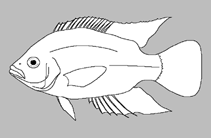
Spine dorsali (totale) : 17 - 19; Raggi dorsali molli (totale) : 7 - 10; Spine anali: 3; Raggi anali molli: 7 - 9. Diagnosis: Labeotropheus aurantinfra differs from all other Labeotropheus due to the extensive distribution of orange pigmentation throughout the body, including the maxilla, the preopercular margin, the branchiostegals, the gular and anterior abdomen region, and the flanks; although orange pigmentation is more common and more extensive in males, it is also present in the same body regions in females (Ref. 128773). It differs from the slender-bodied Labeotropheus, L. trewavasae, L. simoneae, L. chirangali, but not L. rubidorsalis, due to its greater body depth, 33.8-41.5% of standard length vs. 26.3-33.4% in L. trewavasae, 26.9-30.8% in L. simoneae and 26.6-33.2% in L. chirangali; while L. aurantinfra does have a deeper body than L. rubidorsalis, the ranges overlap, 33.8-41.5% of standard length vs. 31.6-36.1%; Labeotropheus aurantinfra has a greater distance between the origin of the dorsal fin and the attachment of the pelvic fins, 33.4-40.4% of standard length vs. 31.5-35.4%, a shorter lower jaw, 22.5-31.6% of head length vs. 29.9-38.5%, more rows of teeth in the upper jaw, 4-6 vs. 3-4, and a greater total number of gillrakers, 10-15 vs. 9-11, than L. rubidorsalis (Ref. 128773). The primary distinction between L. aurantinfra and the other robust-bodied Labeotropheus is the unique distribution of yellow-orange pigmentation across the body, especially in the males; the morphometric and meristic values largely overlap with the other robust Labeotropheus, although there are some distinctions; Labeotropheus aurantinfra has a typically greater distance between the tip of the snout and the origin of the dorsal fin than L. fuelleborni, 31.8-37.4% of standard length vs. 30.7-33.8%, a typically greater distance between the origin of the dorsal fin and the insertion of the anal fin than L. fuelleborni, 60.8-69.5% of standard length vs. 55.1-64.9%, and typically more anal-fin rays than L. fuelleborni, 7-9 vs. 6-7; compared to L. chlorosiglos, L. aurantinfra has a greater eye diameter, 23.5-32.4% of head length vs. 22.6-25.5%, a longer rostral length, 36.1-51.1% of head length vs. 34.7-41.1%, a greater pectoral width, 13.2-18.9% of standard length vs. 12.7-14.3%, and a greater number of scale rows between the pectoral and pelvic fins, 9-12 vs. 6-9; it differs from L. artatorostris due to its greater rostral length, 36.1-51.1% of head length vs. 22.9-43.7%, a larger snout pad, 10.5-19.4% of head length vs. 7.4-16.1%, and more infraorbital neuromasts, 25-40 vs. 12-36; it differs from L. obscurus due to a typically shorter lower jaw, 22.5-31.6% of head length vs. 27.6-40.4%, a greater number of rows of teeth in the upper jaw, 4-6 vs. 3-4, and a greater number of teeth in the left half of the lower jaw, 24-37 vs. 20-26; it differs from L. candipygia due to a greater distance between the origin of the dorsal fin and the insertion of the anal fin, 60.7-69.6% of standard length vs. 50.6-66.8%, and a greater head depth, 86.0-116.6% of head length vs. 87.9-108.1% (Ref. 128773).
Ciclo vitale e comportamento di accoppiamento
Maturità | Riproduzione | Deposizione | Uova | Fecondità | Larve
Pauers, M.J. and T.B. Phiri, 2023. Six new species of Labeotropheus (Cichliformes: Cichlidae) from the Malawian shore of Lake Malawi, Africa. Ichthyology & Herpetology 111(2):264-292. (Ref. 128773)
Stato della Lista Rossa IUCN (Ref. 130435: Version 2025-2 (Global))
Minaccia per l'uomo
Harmless
Usi umani
Pesca: di nessun interesse
Strumenti
Rapporti speciali
Scarica XML
Fonti Internet
Stime basate su modelli
Indice di diversità filogenetica (Fonte Biblio.
82804): PD
50 = 0.5005 [Uniqueness, from 0.5 = low to 2.0 = high].
Bayesian length-weight: a=0.01445 (0.00671 - 0.03113), b=2.99 (2.82 - 3.16), in cm total length, based on LWR estimates for this (Sub)family-body shape (Ref.
93245).
Livello trofico (Fonte Biblio.
69278): 3.4 ±0.4 se; based on size and trophs of closest relatives
Resilienza (Fonte Biblio.
120179): Alto, tempo minimo di raddoppiamento della popolazione meno di 15 mesi (Preliminary K or Fecundity.).
Vulnerabilità della pesca (Ref.
59153): Low vulnerability (10 of 100).
🛈