>
Gobiiformes (Gobies) >
Gobiidae (Gobies) > Gobiinae
Etymology: Varicus: Latin, varix = dilated vein (Ref. 45335); decorum: Species name from the Latin word for 'decorated', 'adorned', 'beautiful' or ''elegant', in reference to the beuatiful round yellow markings on the dorsal surface of the body (Ref. 113825).
Milieu: milieu / Klimaatzone / Diepte / verspreidingsgebied
Ecologie
marien demersaal; diepte 99 - 251 m (Ref. 113825). Tropical
Western Central Atlantic: Curacao.
Grootte / Gewicht / Leeftijd
Maturiteit: Lm ? range ? - ? cm
Max length : 4.1 cm SL mannelijk / geslacht onbekend; (Ref. 113825); 4.6 cm SL (female)
Korte beschrijving
Determinatiesleutels | Morfologie | Morfometrie
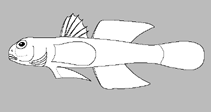
Anale zachte stralen: 7 - 8; Wervels: 27. This species can be distinguished by the following set of characters: D1 VII, without notably elongate spines; D2 I,9; A I,7-8; pectoral fin with 17 rays, 5th and 6th rays from ventral very elongate, extending well beyond other rays of fin, giving pectoral fin an asymmetrical appearance; pelvic fins I, 5, well separated with 5th pelvic-fin ray ca. 1/3-1/5 length of 4th, all pelvic-fin rays unbranched and some may have flattened fleshy tips; body and head entirely naked except for 2 modified ctenoid scales with enlarged ctenii present on each side of caudal-fin base; interorbital papillae row pb’ and pc’ present; no cephalic lateralis pores on head or preopercle present; single anal-fin pterygiophore inserted anterior to haemal arch; D1 fin with scattered yellow spots in life, some with small dark centers; dorsal surface of body with prominent round yellow circles of varying sizes; side of head with two distinct narrow yellow vertical stripes, one through eye and one through posterior margin of preopercle (Ref. 113825).
Cross section: oval.
Known from deep reefs. Collected from sandy habitats with scattered rocks and calcareous rubble. This species perch on open sand and retreat into crevices when disturbed (Ref. 113825).
Levenscyclus en paargedrag
Maturiteit | Voortplanting | Paaien | Eieren | Fecunditeit | Larven
Tornabene, L., J.L. Van Tassel, D.R. Robertson and C.C. Baldwin, 2016. Molecular phylogeny, analysis of discrete character evolution, and submersible collections facilitate a new classification for a diverse group of gobies (Teleostei: Gobiidae: Gobiosomatini: Nes subgroup), with descriptions of nine new species. Zoological Journal of the Linnean Society 177(4):764-812. (Ref. 113825)
Status op de Rode Lijst van het IUCN (Ref. 130435: Version 2025-2 (Global))
Gevaar voor de mens
Harmless
Gebruik door de mens
Tools
Speciale rapporten
Download XML
Internetbronnen
Schattingen op basis van modellen
Fylogenetische diversiteitsindex (Ref.
82804): PD
50 = 0.5010 [Uniqueness, from 0.5 = low to 2.0 = high].
Bayesian length-weight: a=0.00741 (0.00347 - 0.01582), b=3.09 (2.91 - 3.27), in cm total length, based on LWR estimates for this (Sub)family-body shape (Ref.
93245).
Trofisch niveau (Ref.
69278): 3.2 ±0.3 se; based on size and trophs of closest relatives
Weerstandsvermogen (Ref.
120179): Hoog, minimale populatieverdubbelingstijd minder dan 15 maanden (Preliminary K or Fecundity.).
Kwetsbaarheid van de visserij (Ref.
59153): Low vulnerability (10 of 100).
🛈