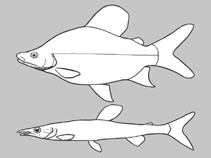
Классификация / Имена
народные названия | синонимы | Catalog of Fishes(род, виды) | ITIS | CoL | WoRMS | Cloffa
>
Characiformes (Characins) >
Distichodontidae (Distichodus)
Etymology: Distichodus: Greek, di = two + Greek, stix, stichos = line, row (Ref. 45335); mbiniensis: The specific epithet refers to the Mbini River which is the Ndowe name for the Rio Wele; the Ndowe are Bantu-speaking people that live along the coastal region in Equatorial Guinea (Ref. 127217).
Окружающая среда: среда / климатическая зона / пределы глубины / диапазон распространения
экология
; пресноводный донно-пелагический. Tropical
Africa: upper Mbini River drainage in Equatorial Guinea (Ref. 127217), but may also occur within this drainage in Gabon (Ref. 127217).
Размер / Вес / Возраст
половая зрелость: Lm ? range ? - ? cm
Max length : 12.2 cm SL самец/пол неопределен; (Ref. 127217)
Краткое описание
определительные ключи | морфология | морфометрия
колючие лучи спинного плавника (общее число) : 0; членистые (мягкие) лучи спинного плавника (общее число) : 16 - 18; колючие лучи анального плавника: 0; членистые (мягкие) лучи анального плавника: 13 - 14. Diagnosis: Distichodus mbiniensis is readily distinguished from the larger-bodied, higher-scale count Distichodus species (D. antonii, D. atroventralis, D. fasciolatus, D. lusosso, D. mossambicus, D. sexfasciatus, D. langi, D. rostratus, D. engycephalus, D. kasaiensis, D. ingae, D. polli, D. petersii, D. nefasch, D. brevipinnis and D. schenga) in having fewer lateral line scales, 40-42 vs. more than 60, and in achieving a smaller maximum standard length, less than 15 cm vs. more than 30 cm (Ref. 127217). This species is also distinguished from the smaller-bodied, lower-scale count Distichodus species in the following ways: Distichodus mbiniensis is distinguished from D. decemmaculatus and D. teugelsi in having two rows of teeth on the lower jaw vs. one; it can be readily distinguished from D. noboli, D. hypostomatus and D. maculatus in having fewer scales along the lateral line, 40-42 vs. 45, 53-60 and 75 respectively, and distinguished from D. rufigiensis in not having prominent vertical bars along the sides; it is distinguished from D. kolleri in having fewer dorsal-fin rays, 16-18 total vs. 21-26, and distinguished from D. altus and D. affinis in having fewer total anal-fin rays, 13-14 vs. 21-22 (Ref. 127217). Distichodus mbiniensis is distinguished from D. notospilus in having more scales along the lateral line, 41-42, rarely 40, vs. 37-39, rarely 40, a much less prominent elongated dark spot at the base of the caudal fin, a shorter dorsal fin, 21.4-27.2% of standard length vs. 22.7-34.2%, and shallower caudal peduncle, 11.8-13.0% of standard length vs. 12.3-14.1%; it is distinguished from D. microps in having a deeper body, usually seven scales from lateral line to the pelvic fin vs. six, a subterminal mouth vs. the nearly inferior mouth of D. microps, a shallower, 11.8-13.0% of standard length vs. 12.4-14.2%, and shorter caudal peduncle, 9.7-12.6% of standard length vs. 11.9-14.8%, a larger eye, 58.6-88.0% of snout length vs. 56.7-80.4%, a wider subopercle, and a shallower infraorbital 1 with a more curved anterolateral margin vs. a deeper infraorbital 1 with a more rectangular anterolateral margin in D. microps (Ref. 127217).
Жизненный цикл и брачное поведение
половая зрелость | размножение | нерест | икра | Плодовитость | личинки
Schmidt, R.C., E.C. Knobloch and C. Barrientos, 2021. Cast netting new species: integrative taxonomy of Distichodus notospilus (Characiformes: Distichodontidae) discovers new species and overlooked areas of endemism in Central Africa. Zootaxa 4952(2):291-313. (Ref. 127217)
Статус Красного Списка МСОП (Ref. 130435: Version 2025-2 (Global))
Угроза для людей
Harmless
Использование человеком
дополнительная информация
инструменты
Специальные отчеты
Скачать в формате XML
ресурсы в Интернет
Оценки, основанные на моделях
Индекс филогенетического разнообразия (ссылка
82804): PD
50 = 0.5000 [Uniqueness, from 0.5 = low to 2.0 = high].
Bayesian length-weight: a=0.01445 (0.00602 - 0.03469), b=3.05 (2.86 - 3.24), in cm total length, based on LWR estimates for this Genus-body shape (Ref.
93245).
Уязвимость рыбной ловли (Ref.
59153): Low vulnerability (10 of 100).
🛈