Klassifizierung / Names
Namen | Synonyme | Catalog of Fishes(Gattung, Arten) | ITIS | CoL | WoRMS | Cloffa
>
Characiformes (Characins) >
Distichodontidae (Distichodus)
Etymology: Distichodus: Greek, di = two + Greek, stix, stichos = line, row (Ref. 45335); mbiniensis: The specific epithet refers to the Mbini River which is the Ndowe name for the Rio Wele; the Ndowe are Bantu-speaking people that live along the coastal region in Equatorial Guinea (Ref. 127217).
Umwelt: Milieu / Klimazone / Tiefenbereich / Verbreitungsgebiet
Ökologie
; süßwasser benthopelagisch. Tropical
Africa: upper Mbini River drainage in Equatorial Guinea (Ref. 127217), but may also occur within this drainage in Gabon (Ref. 127217).
Größe / Gewicht / Alter
Geschlechtsreife: Lm ? range ? - ? cm
Max length : 12.2 cm SL Männchen/unbestimmt; (Ref. 127217)
Kurzbeschreibung
Bestimmungsschlüssel | Morphologie | Morphometrie
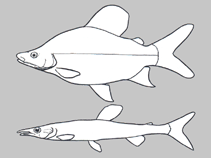
Rückenflossenstacheln (insgesamt) : 0; Rückenflossenweichstrahlen (insgesamt) : 16 - 18; Afterflossenstacheln: 0; Afterflossenweichstrahlen: 13 - 14. Diagnosis: Distichodus mbiniensis is readily distinguished from the larger-bodied, higher-scale count Distichodus species (D. antonii, D. atroventralis, D. fasciolatus, D. lusosso, D. mossambicus, D. sexfasciatus, D. langi, D. rostratus, D. engycephalus, D. kasaiensis, D. ingae, D. polli, D. petersii, D. nefasch, D. brevipinnis and D. schenga) in having fewer lateral line scales, 40-42 vs. more than 60, and in achieving a smaller maximum standard length, less than 15 cm vs. more than 30 cm (Ref. 127217). This species is also distinguished from the smaller-bodied, lower-scale count Distichodus species in the following ways: Distichodus mbiniensis is distinguished from D. decemmaculatus and D. teugelsi in having two rows of teeth on the lower jaw vs. one; it can be readily distinguished from D. noboli, D. hypostomatus and D. maculatus in having fewer scales along the lateral line, 40-42 vs. 45, 53-60 and 75 respectively, and distinguished from D. rufigiensis in not having prominent vertical bars along the sides; it is distinguished from D. kolleri in having fewer dorsal-fin rays, 16-18 total vs. 21-26, and distinguished from D. altus and D. affinis in having fewer total anal-fin rays, 13-14 vs. 21-22 (Ref. 127217). Distichodus mbiniensis is distinguished from D. notospilus in having more scales along the lateral line, 41-42, rarely 40, vs. 37-39, rarely 40, a much less prominent elongated dark spot at the base of the caudal fin, a shorter dorsal fin, 21.4-27.2% of standard length vs. 22.7-34.2%, and shallower caudal peduncle, 11.8-13.0% of standard length vs. 12.3-14.1%; it is distinguished from D. microps in having a deeper body, usually seven scales from lateral line to the pelvic fin vs. six, a subterminal mouth vs. the nearly inferior mouth of D. microps, a shallower, 11.8-13.0% of standard length vs. 12.4-14.2%, and shorter caudal peduncle, 9.7-12.6% of standard length vs. 11.9-14.8%, a larger eye, 58.6-88.0% of snout length vs. 56.7-80.4%, a wider subopercle, and a shallower infraorbital 1 with a more curved anterolateral margin vs. a deeper infraorbital 1 with a more rectangular anterolateral margin in D. microps (Ref. 127217).
Lebenszyklus und Paarungsverhalten
Geschlechtsreife | Fortpflanzung | Ablaichen | Eier | Fruchtbarkeit | Larven
Schmidt, R.C., E.C. Knobloch and C. Barrientos, 2021. Cast netting new species: integrative taxonomy of Distichodus notospilus (Characiformes: Distichodontidae) discovers new species and overlooked areas of endemism in Central Africa. Zootaxa 4952(2):291-313. (Ref. 127217)
IUCN Rote Liste Status (Ref. 130435: Version 2025-2 (Global))
Bedrohung für Menschen
Harmless
Nutzung durch Menschen
Tools
Zusatzinformationen
Download XML
Internet Quellen
Schätzungen auf der Grundlage von Modellen
Phylogenetischer Diversitätsindex (Ref.
82804): PD
50 = 0.5000 [Uniqueness, from 0.5 = low to 2.0 = high].
Bayesian length-weight: a=0.01445 (0.00602 - 0.03469), b=3.05 (2.86 - 3.24), in cm total length, based on LWR estimates for this Genus-body shape (Ref.
93245).
Anfälligkeit der Fischerei (Ref.
59153): Low vulnerability (10 of 100).
🛈