Elasmobranchii (tubarões e raias) (sharks and rays) >
Squaliformes (Sleeper and dogfish sharks) >
Squalidae (Dogfish sharks)
Etymology: Squalus: Genus name from Latin 'squalus' meaning shark (Ref. 6885, 27436); hawaiiensis: Named for its type locality, Hawaii.
Ambiente: milieu / zona climática / intervalo de profundidade / gama de distribuição
Ecologia
marinhas bentopelágico. Tropical
Eastern Central Pacific: Hawaii.
Tamanho / Peso / Idade
Maturidade: Lm ? range ? - ? cm
Max length : 101 cm TL macho/indeterminado; (Ref. 126986)
Descrição breve
Chaves de identificação | Morfologia | Morfometria
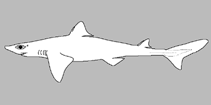
This large species of Squalus of the ‘mitsukurii group’ is distinguished by the following set of characters: body is relatively slender, trunk height 8.7-12.4% TL (mean 10.1% TL); snout angular and short to moderate in length, its mouth width 1.35-1.60 (1.48) times horizontal prenarial length and pre-oral length 1.92-2.06 (1.97) times the prenarial length; pre-first dorsal length 30.3-31.5 (30.2)% TL; pre-second dorsal length 63.6-67.0 (65.5)% TL; interdorsal space 26.7-30.0 (28.6)% TL; pelvic-caudal space 25.2-29.3 (27.1)% TL; dorsal fins relatively small and upright; first dorsal fin length 11.4-12.8 (12.2)% TL, height 6.5-7.8 (7.3)% TL, with inner margin length 4.9-5.7 (5.4)%% TL; second dorsal fin length 10.6-11.7 (11.1)% TL, its height 4.0-4.6 (4.4)% TL and inner margin length 4.3-4.9 (4.6)% TL; first dorsal fin spine length 46.6-64.6 (55.6)% of first dorsal fin height; second dorsal spine length 104.5-114.5 (109.0)% of second dorsal fin height; caudal bar triangular, extending from caudal fork nearly to the anterior edge of the lower caudal, distinct upper caudal blotch and fringe present in juveniles, upper caudal blotch diffuse in adults but extending to posterior margin of the upper caudal fin, the upper and lower caudal fins white tipped; flank denticles tricuspid; teeth similar in appearance in upper and lower jaws, numbers ranging from 26-28 in the upper jaw and 23 in the lower; monospondylous centra 41-42, precaudal centra 85-89, total centra 112-116 (Ref. 126986).
Cross section: angular.
Ciclo de vida e comportamento de acasalamento
Maturidade | Reprodução | Desova | Ovos | Fecundidade | Larvas
Sarmento-Soares, L.M. and R.F. Martins-Pinheiro, 2020. A reappraisal of phylogenetic relationships among auchenipterid catfishes of the subfamily Centromochlinae and diagnosis of its genera (Teleostei: Siluriformes). Proc. Acad. Natural Sci. Philadelphia 167(1):85-146. (Ref. 126986)
Categoria na Lista Vermelha da IUCN (Ref. 130435: Version 2025-2 (Global))
Ameaça para o homem
Harmless
Utilização humana
Pescarias: de interesse potencial
Ferramentas
Relatórios especiais
Descarregue XML
Fontes da internet
Estimativas baseadas em modelos
Índice de diversidade filogenética (Ref.
82804): PD
50 = 0.5000 [Uniqueness, from 0.5 = low to 2.0 = high].
Bayesian length-weight: a=0.00347 (0.00163 - 0.00737), b=3.09 (2.92 - 3.26), in cm total length, based on LWR estimates for this Genus-body shape (Ref.
93245).
Nível Trófico (Ref.
69278): 4.4 ±0.4 se; based on size and trophs of closest relatives
Resiliência (Ref.
120179): Muito baixo, tempo mínimo de duplicação da população maior que 14 anos (Preliminary K or Fecundity.).
Vulnerabilidade da pesca (Ref.
59153): High vulnerability (61 of 100).
🛈