Elasmobranchii (haaien en roggen) (sharks and rays) >
Squaliformes (Sleeper and dogfish sharks) >
Squalidae (Dogfish sharks)
Etymology: Squalus: Genus name from Latin 'squalus' meaning shark (Ref. 6885, 27436); hawaiiensis: Named for its type locality, Hawaii.
Milieu: milieu / Klimaatzone / Diepte / verspreidingsgebied
Ecologie
marien benthopelagisch. Tropical
Eastern Central Pacific: Hawaii.
Grootte / Gewicht / Leeftijd
Maturiteit: Lm ? range ? - ? cm
Max length : 101 cm TL mannelijk / geslacht onbekend; (Ref. 126986)
Korte beschrijving
Determinatiesleutels | Morfologie | Morfometrie
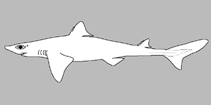
This large species of Squalus of the ‘mitsukurii group’ is distinguished by the following set of characters: body is relatively slender, trunk height 8.7-12.4% TL (mean 10.1% TL); snout angular and short to moderate in length, its mouth width 1.35-1.60 (1.48) times horizontal prenarial length and pre-oral length 1.92-2.06 (1.97) times the prenarial length; pre-first dorsal length 30.3-31.5 (30.2)% TL; pre-second dorsal length 63.6-67.0 (65.5)% TL; interdorsal space 26.7-30.0 (28.6)% TL; pelvic-caudal space 25.2-29.3 (27.1)% TL; dorsal fins relatively small and upright; first dorsal fin length 11.4-12.8 (12.2)% TL, height 6.5-7.8 (7.3)% TL, with inner margin length 4.9-5.7 (5.4)%% TL; second dorsal fin length 10.6-11.7 (11.1)% TL, its height 4.0-4.6 (4.4)% TL and inner margin length 4.3-4.9 (4.6)% TL; first dorsal fin spine length 46.6-64.6 (55.6)% of first dorsal fin height; second dorsal spine length 104.5-114.5 (109.0)% of second dorsal fin height; caudal bar triangular, extending from caudal fork nearly to the anterior edge of the lower caudal, distinct upper caudal blotch and fringe present in juveniles, upper caudal blotch diffuse in adults but extending to posterior margin of the upper caudal fin, the upper and lower caudal fins white tipped; flank denticles tricuspid; teeth similar in appearance in upper and lower jaws, numbers ranging from 26-28 in the upper jaw and 23 in the lower; monospondylous centra 41-42, precaudal centra 85-89, total centra 112-116 (Ref. 126986).
Cross section: angular.
Levenscyclus en paargedrag
Maturiteit | Voortplanting | Paaien | Eieren | Fecunditeit | Larven
Sarmento-Soares, L.M. and R.F. Martins-Pinheiro, 2020. A reappraisal of phylogenetic relationships among auchenipterid catfishes of the subfamily Centromochlinae and diagnosis of its genera (Teleostei: Siluriformes). Proc. Acad. Natural Sci. Philadelphia 167(1):85-146. (Ref. 126986)
Status op de Rode Lijst van het IUCN (Ref. 130435: Version 2025-2 (Global))
Gevaar voor de mens
Harmless
Gebruik door de mens
Visserij: van potentieel belang
Tools
Speciale rapporten
Download XML
Internetbronnen
Schattingen op basis van modellen
Fylogenetische diversiteitsindex (Ref.
82804): PD
50 = 0.5000 [Uniqueness, from 0.5 = low to 2.0 = high].
Bayesian length-weight: a=0.00347 (0.00163 - 0.00737), b=3.09 (2.92 - 3.26), in cm total length, based on LWR estimates for this Genus-body shape (Ref.
93245).
Trofisch niveau (Ref.
69278): 4.4 ±0.4 se; based on size and trophs of closest relatives
Weerstandsvermogen (Ref.
120179): Zeer laag, minimale populatieverdubbelingstijd meer dan 14 jaar (Preliminary K or Fecundity.).
Kwetsbaarheid van de visserij (Ref.
59153): High vulnerability (61 of 100).
🛈