>
Gobiiformes (Gobies) >
Gobiidae (Gobies) > Gobionellinae
Etymology: Pseudogobius: Greek, pseudes = false + Latin, gobius = gudgeon (Ref. 45335); aquilonius: Name from Latin 'aquilonius' meaning north or northerly, referring to the species’ distribution around the north coast of Australia.
Entorno: milieu / zona climática / rango de profundidad / gama de distribución
Ecología
marino; salobre demersal; rango de profundidad 0 - 1 m (Ref. 126575). Subtropical
Indo-Western Pacific: Australia (northern Australia from from Dampier, Western Australia to Brisbane, east coast Queensland); possibly New Guinea but no samples were found.
Tamaño / Peso / Edad
Madurez: Lm ? range ? - ? cm
Max length : 3.3 cm SL macho / no sexado; (Ref. 126575)
Descripción breve
Claves de identificación | Morfología | Morfometría
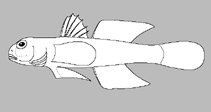
Espinas dorsales (total) : 7; Radios blandos dorsales (total) : 6 - 8; Espinas anales: 1; Radios blandos anales: 6 - 7. This moderate-sized species is distinguished by the following characters: D2 I,6-8 (usually I,7); A I,6-7 (usually 7); pectoral rays 14-17 (usually 16); segmented caudal rays 15-16 in 9/7 pattern; lateral scales 24-27; transverse scale count 7-9; predorsal scales 6-8; opercle with at least 2 rows of cycloid scales and rarely with a cycloid scale on cheek, right behind the eye; shoulder girdle is smooth or with a narrow bony flange; tongue is short, may be greatly reduced; in males, teeth in outer row of upper jaw are slightly flattened, blunt-tipped or pointed, with two curved symphyseal canines behind anterior tooth rows; females with outer row teeth of upper jaw small, compressed and blunt-tipped; scale margins edged with brown, about 5-6 small brown elongate blotches along mid-side of the body and posteriormost blotch at hypural crease extending onto caudal fin and
coalescing with narrow vertical dark bar on fin base (Ref. 126575),
Cross section: oval.
This species occupies shallow-water estuarine, found in tidal rivers, mangrove creeks and muddy tide-pools, at depths of 0–1 m, on sandy mud, mud and mangrove roots, logs and leaf litter. It is found among a variety of mangroves, e.g. Aegialitis, Avicennia, Ceriops, Exoecaria, Rhizophora and often in marginal habitats such as small drainage creeks that runs through exposed salt flats. Associated with other species in its microhabitat or location in northern Australia including a minor overlap with Pseudogobius eos around Brisbane) (Ref. 126575).
Ciclo vital y comportamiento de apareamiento
Madurez | Reproducción | Puesta | Huevos | Fecundidad | Larva
Larson, H.K. and M.P. Hammer, 2021. A revision of the gobiid fish genus Pseudogobius (Teleostei, Gobiidae, Tridentigerinae), with description of seven new species from Australia and South-east Asia. Zootaxa 4961(1):1-85. (Ref. 126575)
Situación en la Lista Roja de la UICN (Ref. 130435: Version 2025-2 (Global))
Amenaza para el ser humano
Harmless
Usos humanos
Herramientas
Informes especiales
Descargar XML
Fuentes de Internet
Estimaciones basadas en modelos
Índice de diversidad filogenética (Referencia
82804): PD
50 = 0.5000 [Uniqueness, from 0.5 = low to 2.0 = high].
Bayesian length-weight: a=0.00708 (0.00332 - 0.01511), b=3.07 (2.89 - 3.25), in cm total length, based on LWR estimates for this (Sub)family-body shape (Ref.
93245).
Nivel trófico (Referencia
69278): 3.2 ±0.5 se; based on size and trophs of closest relatives
Resiliencia (Referencia
120179): Alto, población duplicada en un tiempo mínimo inferior a 15 meses (Preliminary K or Fecundity.).
Vulnerabilidad pesquera (Ref.
59153): Low vulnerability (10 of 100).
🛈